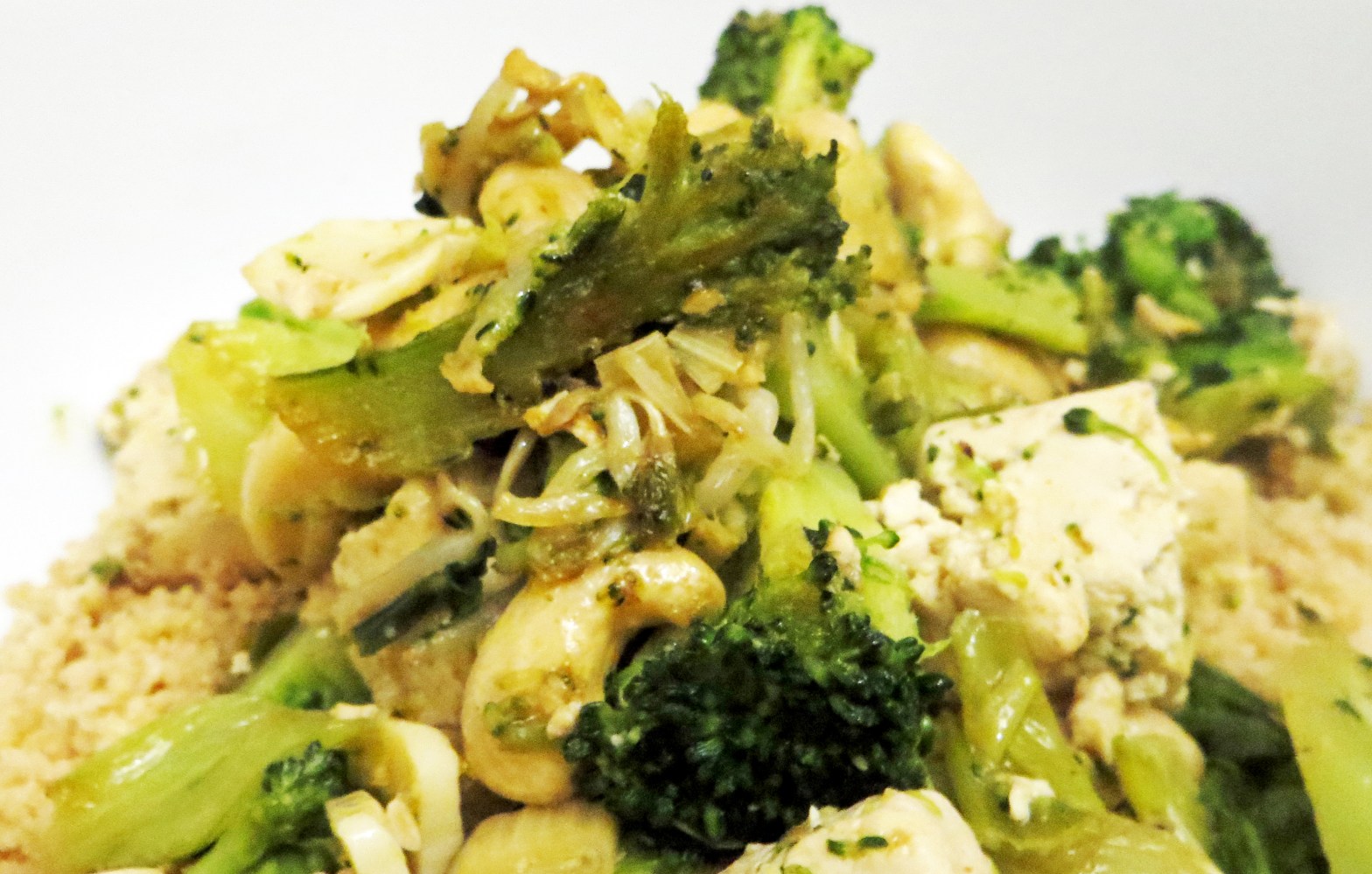
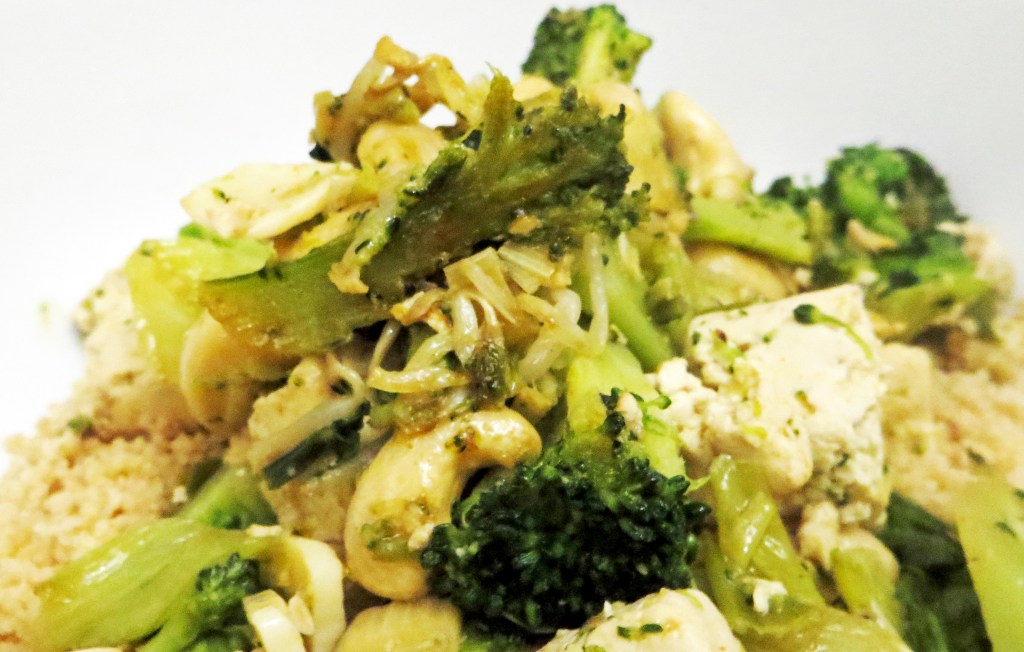
I usually enjoy super simple recipes but today I’m going all out for this oriental treat. Triple green stir fry with the base aroma of toasted sesame, I could be in China! Get you calcium fix for the day, plenty of iron too. Serves 4
Toasted sesame oil – 2-3 tbsps
Bunch of spring onions finely chopped
4-5 cloves of garlic, thinly sliced
Inch square of ginger, thinly sliced
Box choy, roughly chopped into large chunks
tofu (a 400g block, cubed)
bamboo shoots (half a bag)
cashew nuts (a small bag)
small broccoli chopped into batons – boil separately and add at the end
stir in one large dollop of syrup
seasone with parsley, paprika, salt and pepper
add one dollop of peabut butter
optional soya sauce
serve with rice, noodles, or couscous
Add the first eight ingredients gradually, as the broccoli boils (5-7min). Cook the pasta/couscous. Stir fry the veggies continuously for 15 min, or until tofu is heated through. Serve with pasta/couscous, season and add peanut butter.
Last moonth, I was focussing purely on the first chakra. After a warm up of pawanmuktasana around the feet and legs, foot massage and basic poses, I moved into more demanding stretches and dynamic sun salutations. In the standing postures I began to notice how energy moves around the body in Spirals.
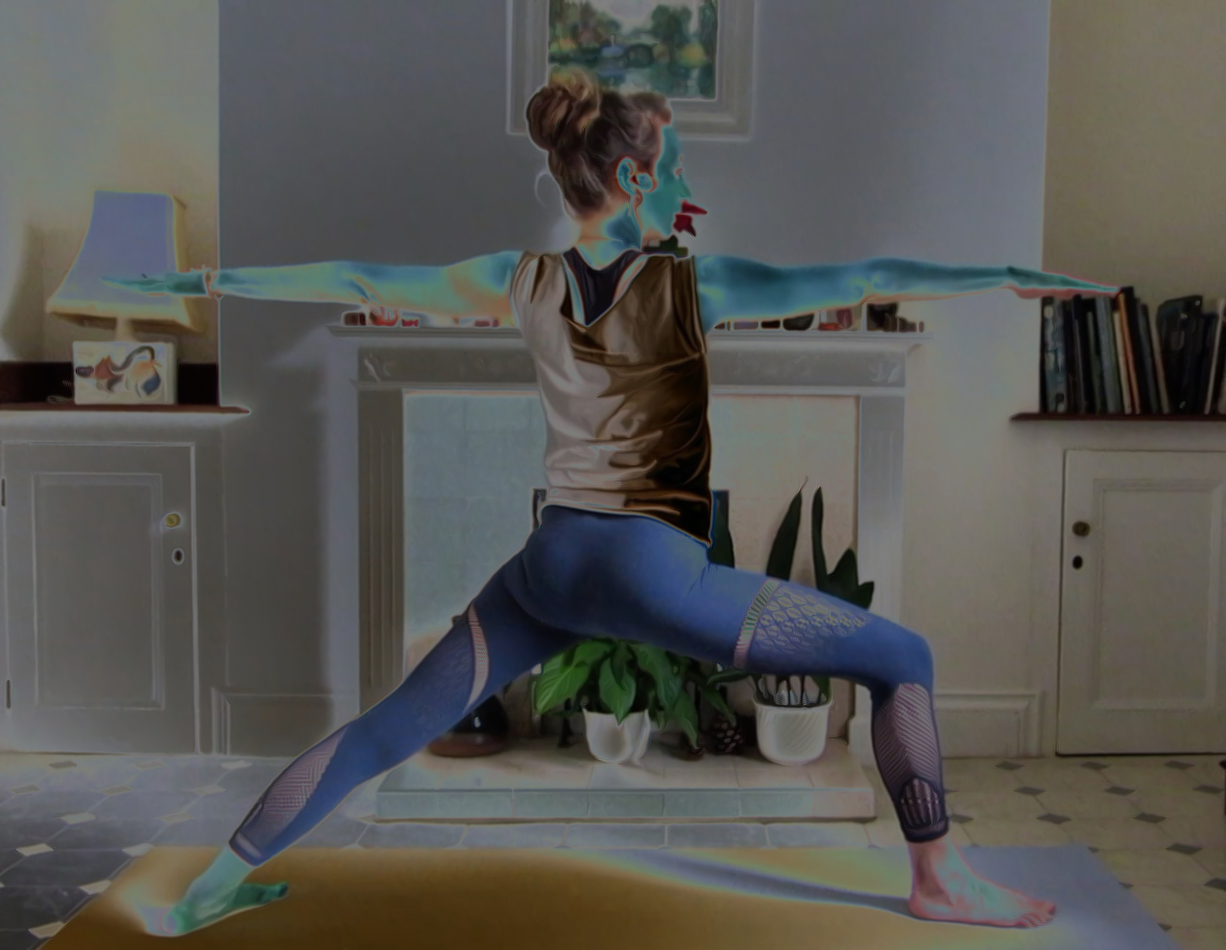
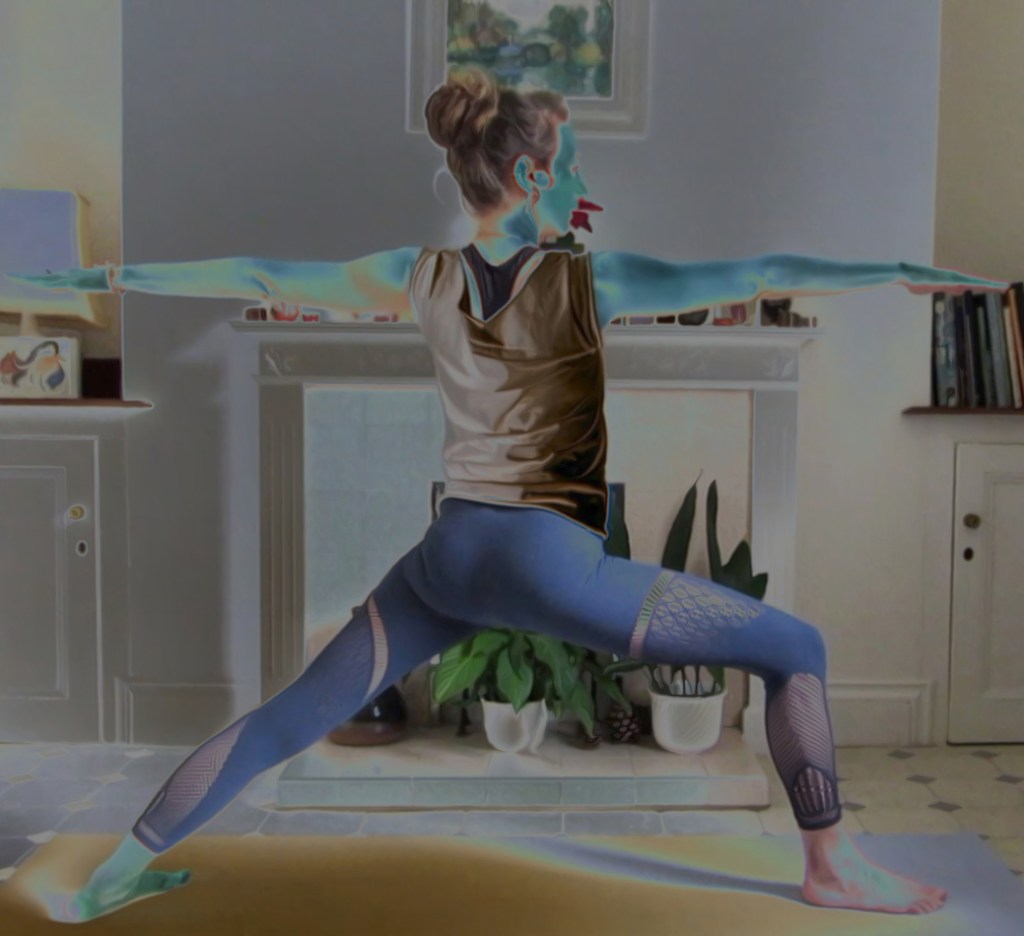
I have always loved working with tensegrity – feeling the stretch in one part o the body by moving another part. Almost as if I was a puppet on strings, I lead with one part of the body and the rest follows, stretching into the shape of the next posture, or even as I breathe, every inhale and exhale introduces me to a deeper place in the posture. As I focus on the root chakra, Warrior I has opened up for me in recent weeks:
As I ground down with the back heel and the big toe of the back leg, I feel energy on both sides riseing up the leg, opening the hip in one direction and straightening the leg on the other. By pressing down through the foot I activate the side body, I feel tensegrity working my lateral muscles, and the effect of grounding down helps me to reach up with my arms at the same time. The energy continues to spiral, Under and around the shoulder to open the chest, and up the arm, finishing at the hand in prayer. I find myself twisting from both sides to create an arch within the palm, extended high over head. On the other side, the front foot, bent at the knee, grounds into the earth, the knee, thigh and hip bracketed by energy moving up the lateral and spiral meridien lines. Again, front arm lines open the chest, culminating in the index fingers pressing together, while the back arm lines close the prayer with little fingers reaching upwards as one. We are at once opening and closing the chest with the prayer to sky dynamic, creating space on the inhale, deepening the stretch on the exhale. Anjali mudra emerges as a natural expression of form. Rather than pressing palms tightly together, the fingers join, but the palms are slightly open ready to receive blessings from the higher realms. The more the feet ground down, the higher the prayer reaches, the more the heart opens.
The energy is moving in diametrically opposed curves: double helices. I feel like one big strand of DNA! The aura pulsates, appearing and disappearing with each heart beat, shfting and changing as the human mind moves through its many forms. I catch a glimpse of the bright light moving around the body. The opposition bring balance, a grouding force that simultanously lifts as it connects to the earth. By working with the feet, the entire body is energised.
I have never found the warrior poses to be very accessible before now. The root chakra shadow emotions of anger, is tied to the idea of our basic survival; anger protects us from danger. This is because anger is associated with the fight mechanism in fight, flight or freeze. As far as we have evolved, anger is now a mask of other emotions like fear and sadness. By working on our root chakra, through standing poses, we may be confronted with stuck negative emotions being released.
The root chakra is by its nature tamasic. Tamas, the least active of the three gunas*, is inert, slow moving, lazy, and heavy. Only by activating the feet and legs do we begin to channel the enrgy upwards. When we observe the opposing spirals, and energise on them with the breath, the muscles of the body come alive, we become empowered. My right ‘to be’ is reinforced and we feel validated.
By projecting the image of perfect spirals emanating from the feet and hands, wrapping around the body, it becomes clear where there are imperfections. Where is the shadow? Where am I holding on whenI should be letting go? What in my aura needs more recognition? By visualising the spirals inherent in our sacred geometry we are able to cultivate the sensation of enlightenment. When we are in perfect balance, we feel at ease and can more readily observe how the spirit is moving through the body’s space. The double helices literally reveal the matrix of the body connecting the earth to the body to the spirit.
*gunas are the three primordial forces of the universe. They comprise tamas, rajas, and sattva: Inertia, activity and purity.
The final in a series of fourteen practices, this moonth’s routine is all about activating sushumna nadi – from the tips of the toes to the crown of the head. Reclining hero and tiptoe fish help overcome fear of opening up your aura to the world...
A few days ago, I was listening to a Youtube video about Saint Anandamayi Ma’s teachings. It recounted how she taught the power of our own life’s challenges in teaching us how to be enlightened. ‘Without life we cannot be enlightened’, she said. When we practice yoga and meditation we are trying to carve a space outside of our normal daily lives to reflect back on it, to see how we act in and react to the situations life presents to us. If we often find ourselves craving peace, or a break from the humdrum of daily life, meditation offers us an alternative state of being, a place to grow our awareness.
Finding myself at a loose end, earlier today, I decided to spend some time in meditation. Breath awareness revealed to me some the energetic knots within my aura, literally tying me in knots. I pursue peace, calling on the unknown infinite source within me to take me into the light, to untie the knots that bind me. I become aware of some of the things in my auric space that I may seek to change. After sitting in silence for a further time, I realise I am bound by something that has been troubling me for some time. Still that ballast does not move. The same characters / forces/ archetypes manipulating my energy field do not relent. I learn to distance myself from them. I am reminded of the old prayer ‘Give me serenity to acept the things I cannot change, the courage to change the things I can, and the wisdom to tell the difference’.
There is a great sadness inside of me. There is anger, rage even, and fear. I remember Anandamayi Ma and her teaching and I wonder why I have been given this lesson in life. Santam Kaur’s song Heart of the Universe echoes in my mind, ‘there is a space that exists, between us, and around us’. She is singing about the magic of the aura. The aura is a mysterious thing; it surrounds the body in layers; it is made up of semi-invisible ethereal substances that science has yet to comprehend; it contains the chakras; it is transtemporal, it transcends linear time.
Reverse warrior, inhale the upper arm reaches back stretching front of body open, exhale windmill the arms forward into extended side angle, opposite arm reaches up and over stretching the side of the body open; the body ebbs and flows through space and time
Yoga offers a space to learn about the aura. When we study the seventh and first chakras together, what connects them but the sushumna, the central current that flows from the base of the spine, the root, up to the crown. This energy system connects the the Human Energy Field to the Universal Energy Field. The human body then is a place where the infinite becomes finite. The paramatman becomes the atman. With every breath we are reborn. The individual’s field contracts and expands pulsating on a human level just moments away from the field of oneness.
We can use yoga to cleanse the auric space around us. The chakras that filter energy through the layers of ethereal fields carry messages about what this incarnation is dealing with at the present time. By repeating the same yoga moves everyday and by working on all seven chakras, it is possible to build up a picture, or energetic map of the things that are bringing peace on the one hand, and dischord, or pain on the other.
Our mind cannot transcent three dimensional reality. The closest to infinity we can get is oscillating between that space of zero and one, existence and nothingness, the beginnng of time, the edge of the universe. The human mind struggles to comprehend the things that are beyond three dimensional reality. Although we act out of unconscious places, and we see ourselves and other people react to the invisible unseen things that float in that space between us, we do not know exactly how it works.
In downward facing corpse, the breath slows, deepening with every inhale. From a whisper it builds to a wave crashing on the shore. The shoulders rounded, the head bowed down, the full back of the body open, the ‘will centres’ (1) of chakras, one to seven, surrender. The front of body is held, the ‘feeling centres’ hidden away, cushioned by the bolster… the mind sinks into nothingness
‘We are more than this body and mind, although we have a body and mind, we are something greater’, as the great sages and gurus say. We are both human and universal consciousness. Integrating the two parts is something that a yogi strives to do. How do I unite with the light, with my fellow humans, with my family? It is a huge question and one that has puzzled philosophers for a very long time. Some people like to work with life’s challenge as part of a tradition, they are called ‘people of the book’. Others keep their thoughts to themselves, their spirit is something private never to be talked about. Personally, I enjoy the traditions of old. The ancient wisdom that is written down, offering clues as a way to proceed.
The light is a facinating subject. Recently I have been especially concerned with its contrast: darkness. I am struck by the self referentiality of meditation, the self reflexivity of consciousness, there is a frame of reference where I step outside myself to see myelf. I know me be being you. By feeling in the darkness, I find myself in light. The infinity of one mirror reflecting another mirror means that, so often, perfect peace evades us, although it holds us, mesmerised, for moments at a time. I clean the mirror of my consciousness, of my human darkness, by seeing through it, by spending time watching me. Through knowing the darkness, by acknowledging pain, illness, separation and suffering I find the light. Pure light is beyond words.
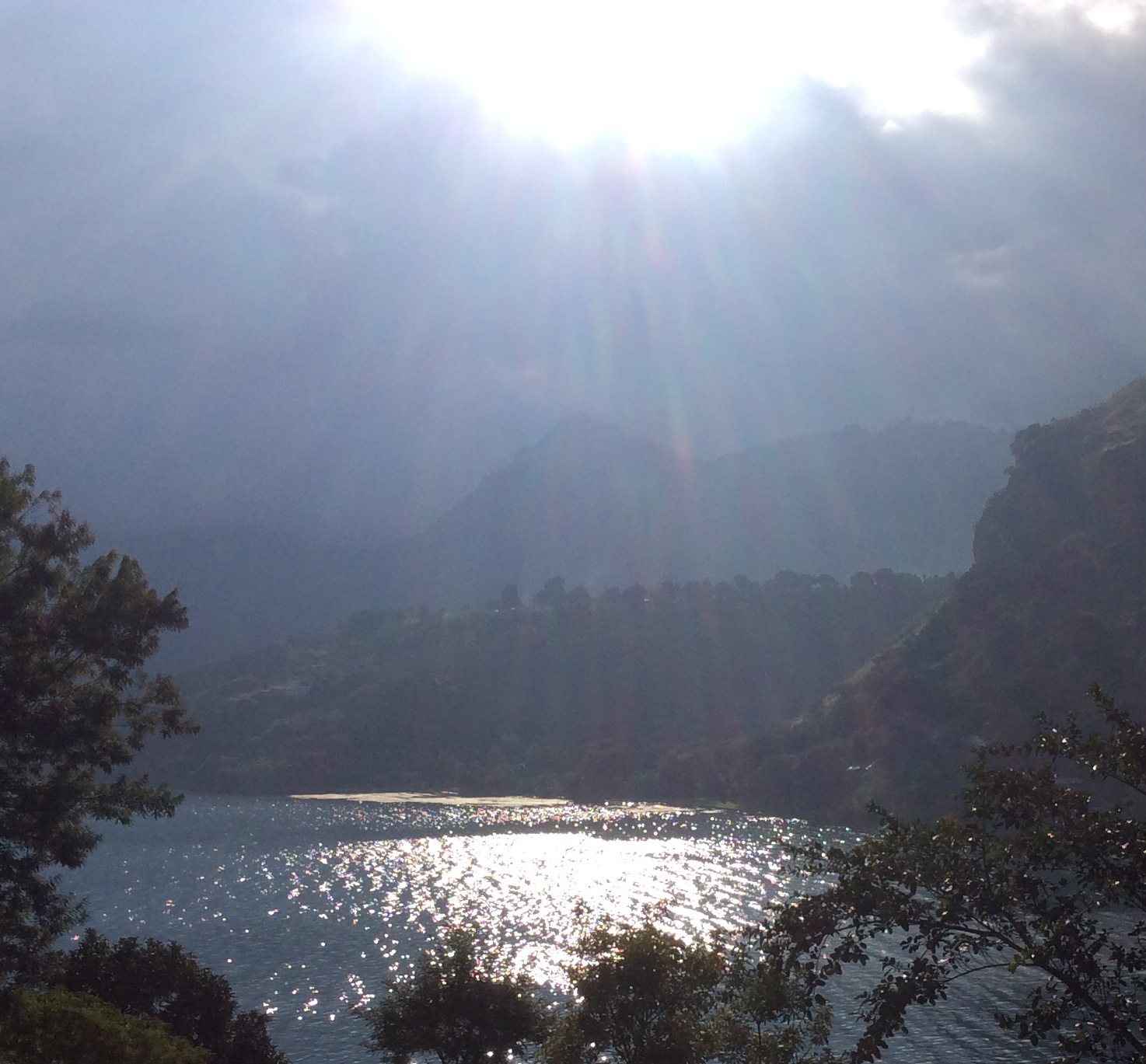
Darkness is an unavoidable part of life. Each moment has the potential for renewal in light, but we must be content to balance the light with darkness. Our auras are ever changing manifestations of light / ether / energy, sometimes vibrating like starlight, other times casting shadows, all a mystery of our existence. We are each a universe within the universe. Infinity reaches towards infinity. Our flesh and bones are made of earth, water courses through our veins, air fills our lungs, and yet somehow we know we are more. Underneath all that we can see theuniversal energy field of oneness. A space where we are not divided by what embodies us, but where we are all one.
(1) Brennan, B. (1987) Hands of Light. USA and Canada, Bantam Books
Unlike the popular use of the term Karma, which means ‘what goes around come around’, Karma yoga strictly means yoga in action. The world karma derives from the root Kr in Sanskrit meaning ‘to act’, ‘to perform’, ‘to sacrifice’. Another Sanskrit word that I use in a similar context to karma is seva, which means selfless service. Both Sanskrit terms refer to working on your self by devoting your time and effort to someone other than yourself. The Bhagavad Gita particularly advocates selfles service as a way to rid the self of the ego.
There are many ways to dedicate the self to something outside of yourself. This week I am reading ‘How Bad Are Bananas?’. It is a book about how much carbon everything on earth uses up. Obviously it doesn list everything, but it covers a wide range of goods and things we use. Carbon dioxide is emitted by almost everything we consume and the average Brit consumes 12 tonnes of carbon every year. The author suggests taking on a 5 tonne target, and slashing your carbon footprint in half. This would be an example of karma yoga. For me, karma yoga means being vegan. This save a tonne of carbon every year and there are no farm animals kept in captivity to feed me.
By practicing karma yoga we can purifiy our chakras. Chakra one is purified as we get to know the self in a new environment. Chakra two purifies the emotions, how do we come into contact with the other in a giving or even subservient role? Chakra three is opened as we put the needs of others above our own. Sometimes this can be painful and creates tapas, or the feeling of austerity. Chakra four, the heart, is likewise cleansed by serving others before the self, the act of giving can open our hearts to a feeling of generosity and abundance. Chakra five is benefitted by honing our communication skills, getting closer to our true self opens the throat chakra and we can speak with a more authentic voice. Chakra six opens as we encounter new perceptions of the world. How do others see things? How does my perspective change by what I experience? And chakra seven is empowered by the light that we find in others. Universal consciousness means the light of consciousness that is in everyone. How do others face the world? How do they communicate? How do they care for me?
When we work on one chakra, we work on all the others at the same time. The seventh is at one end of the seven chakras along the spine. It is said to open us to the higher realms of the spiritual universe. This can include discovering higher realms that aren’t widely known about. I have to thank Barabra Brennan for my latest insight from her book Hand of Light. The idea that there is a spiritual reason for all the physcial, emotional and mental problems that we face can be a relief. The world is beyond our understanding, and it is not necessarily anyone’s fault that things are like they are. I find this makes it easier to accept things as they are, and easier to forgive.
Past lives are often associated with the word karma because it is from past lives that we are working out some of the knots that get tied. Astrology can be insightful as to what the themes of this lifetime represent, and what we are working on in this incarnation. In yoga, the philosophy of karma yoga is extended into future lives. In the Islamic faith there is a philosphy whereby if you don’t get to do something in this life, you can leave it to the next life. I treat the idea of my futue lives in a similar vein. If something feels unresolved and is eating up my energy, I say to myself that it needs to get parked for a future life.
The law of karma affects everyone that you meet, maybe you met them in a past life and in this ife you are working out some unresovled issues, maybe things left unresolved will recur in future lives. Karma has the effect of turning things around. If you feel poor in this life, maybe you were ostentatiously rich in a previous life? Like headstand the ultimate in seventh chakra alignment, karma turns things on its head. Instead of giving, you receive, and vice versa.
Karma yoga, yoga in action, helps to strip down the self by removing the surface level of desires that we automatically function from. What remains as we serve the other? Where are we stuck? Maybe you find yourself asking, Who am I? What makes me tick?
Barabra Brennan states that our life intention, for this life, is held around the head area, close to the seventh chakra. Working on the higer chakras may help activate your innate knowledge of this area.
It is believed that with enough training, a yogi can access information about their past lives, enlightening them as to what remains to be processed in this life. We can function without consciously knowing this information, but it canbe helpful to have a clue. For me, chakra yoga gives me a way in to this awareness. The more I absorb the philosophy of the ancient yogis and the more I focus on each chakra, the more I can tune my body to its life’s course.
The seventh chakra is often overlooked in yoga classes, who wants to teach a class of headstands? There is something scary about approaching the highest chakra. We know so little about it that it can be difficult to teach with the same assurance as say the first chakra when we deal with the physical realm that we can see is right in front of us. It is only by working more on the seventh chakra that I have begun to learn from it, and the books that I read support my growth in that area too. Life is a wonderful, mysterious thing. Too much focus on the higher chakras are somtimes accused of being ungrounding, but through karma yoga we can experience the self in action, action in its true spirit of universal bliss.
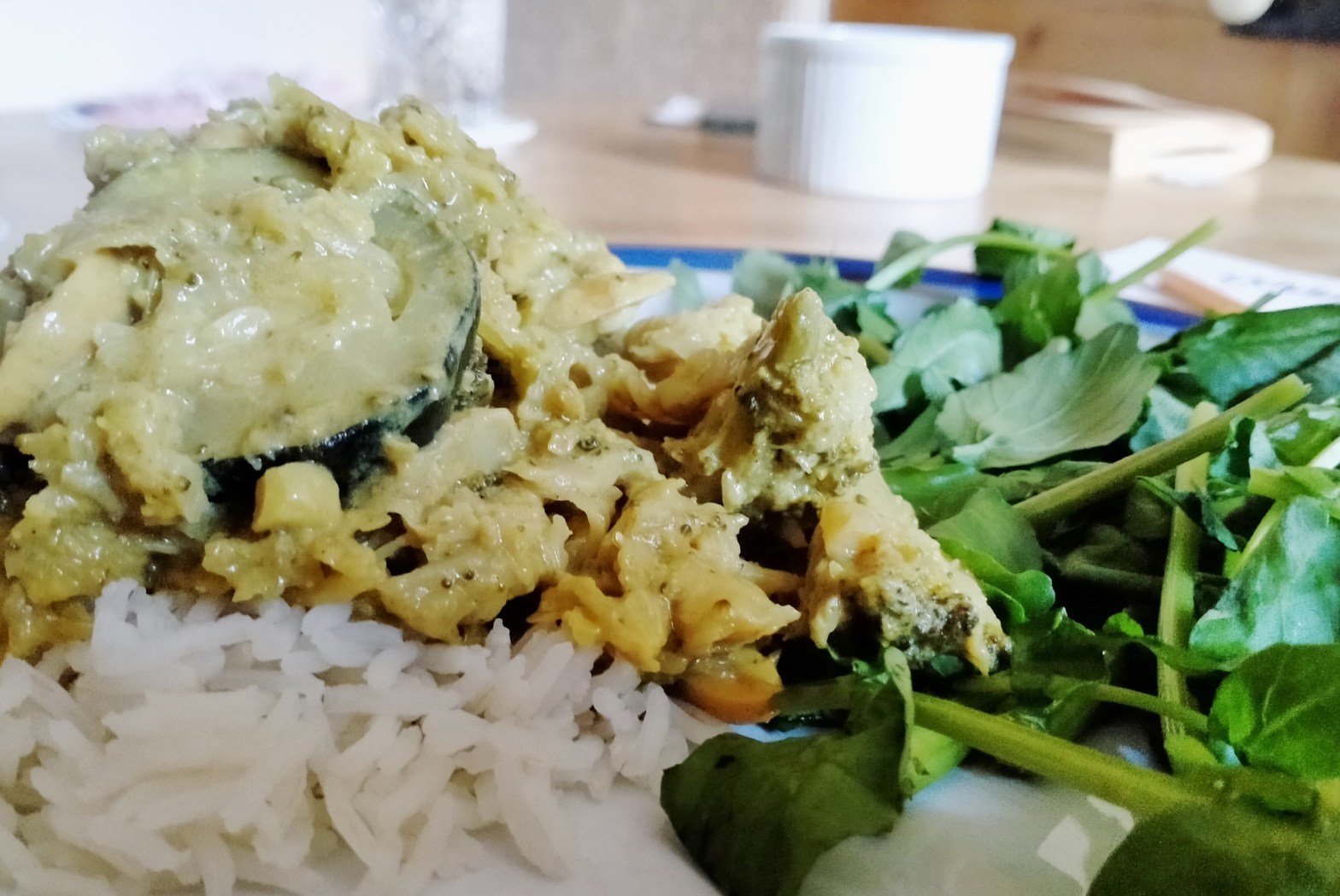
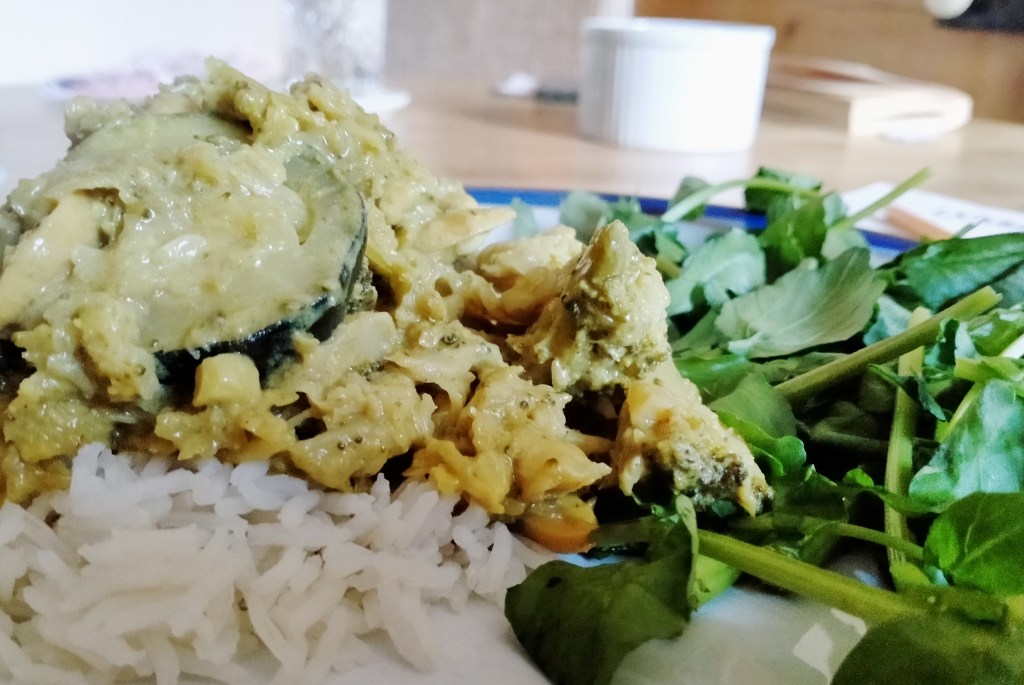
This creamy recipe made with lots of greens can be made mild or spicy depending on your preference. I personally enjoy mild food, and this curry makes for light comfort food, easy to munch with rice or couscous. Serve with leafy green for an extra vitamin boost.
Drizzle of oil
Fennel sliced
Broccoli (small) chopped
Spices (yellow madras mix)
Cashew nuts 200g
Coconut milk (1 can)
Cabbage (1/2 a large or 1 small)
Hot water
Courgette sliced
Salt
Add the spice, salt and oil to a large frying pan and sizzle. Add the fennel and broccoli and fry for 5 minutes until covered in spices. Add the cashew nuts and stir in. Add the coconut milk, stir and bring to the boil. Add the shredded cabbage and enough water so that the mix is not dry. Allow to steam for 15 minutes. Add the courgette and possibly more water – just enough to create some steam and to stop the mixture from becoming dry. Simmer for another 10 minutes et voila. Serve with watercress, salad, or kale along with your choice of grains. Unless your cashews are salted, this dish takes quite a lot of salt so season generously.
A super simple recipe, just needs a hot hot oven! Makes 12 puddings
200g self raising flour
1/2 teaspoon baking powder
50ml water
150ml soya milk
12 drizzles of oil
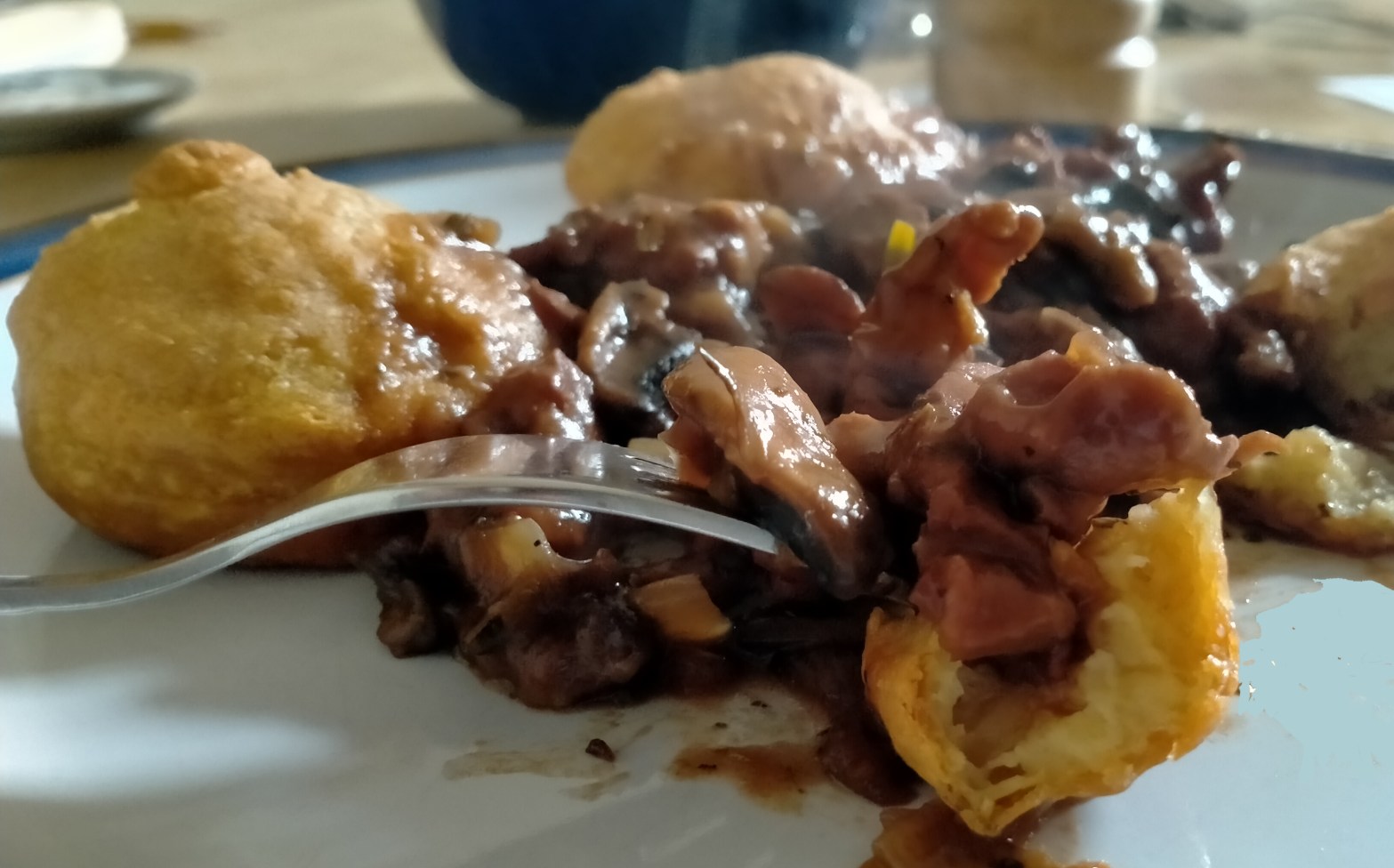
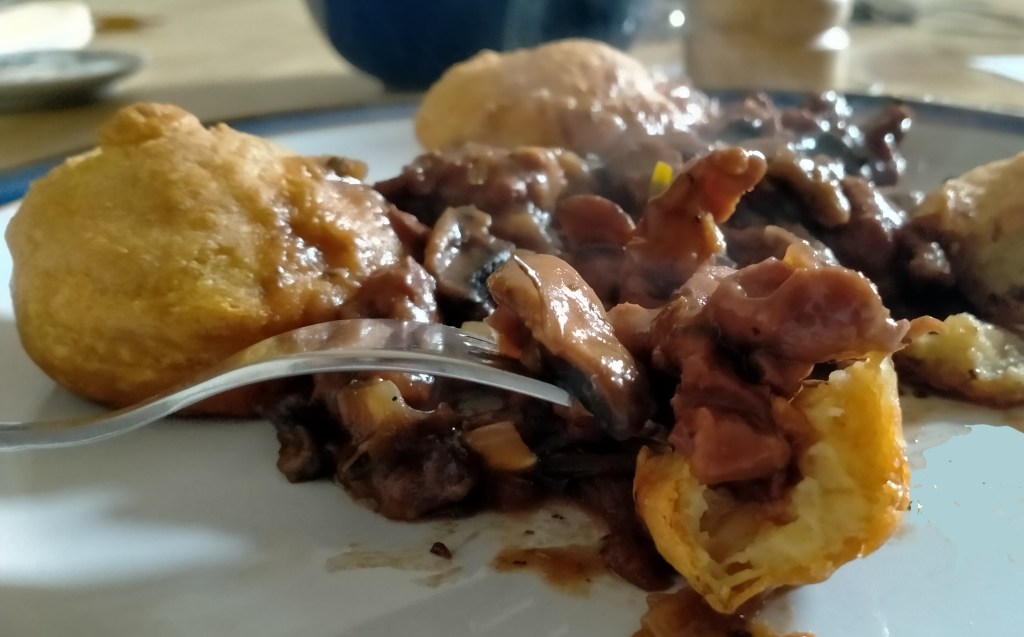
Blend the flour, baking powder, water and milk to create a batter. Pour into a jug, cover and out in fridge for 1 hour. Pre heat oven to gas mark 7. Add oil to each patty in a patty tin and heat in the oven for 5 minutes on the top shelf. Pour batter into each bun hole and bake for 30 minutes. Coordinate with other oven baking, for example with seitan bourguignon, which usually takes an hour on gas mark 4, can sit in the bottom of the oven while the puddings are cooking at a 7 (after 30minutes at a 4)