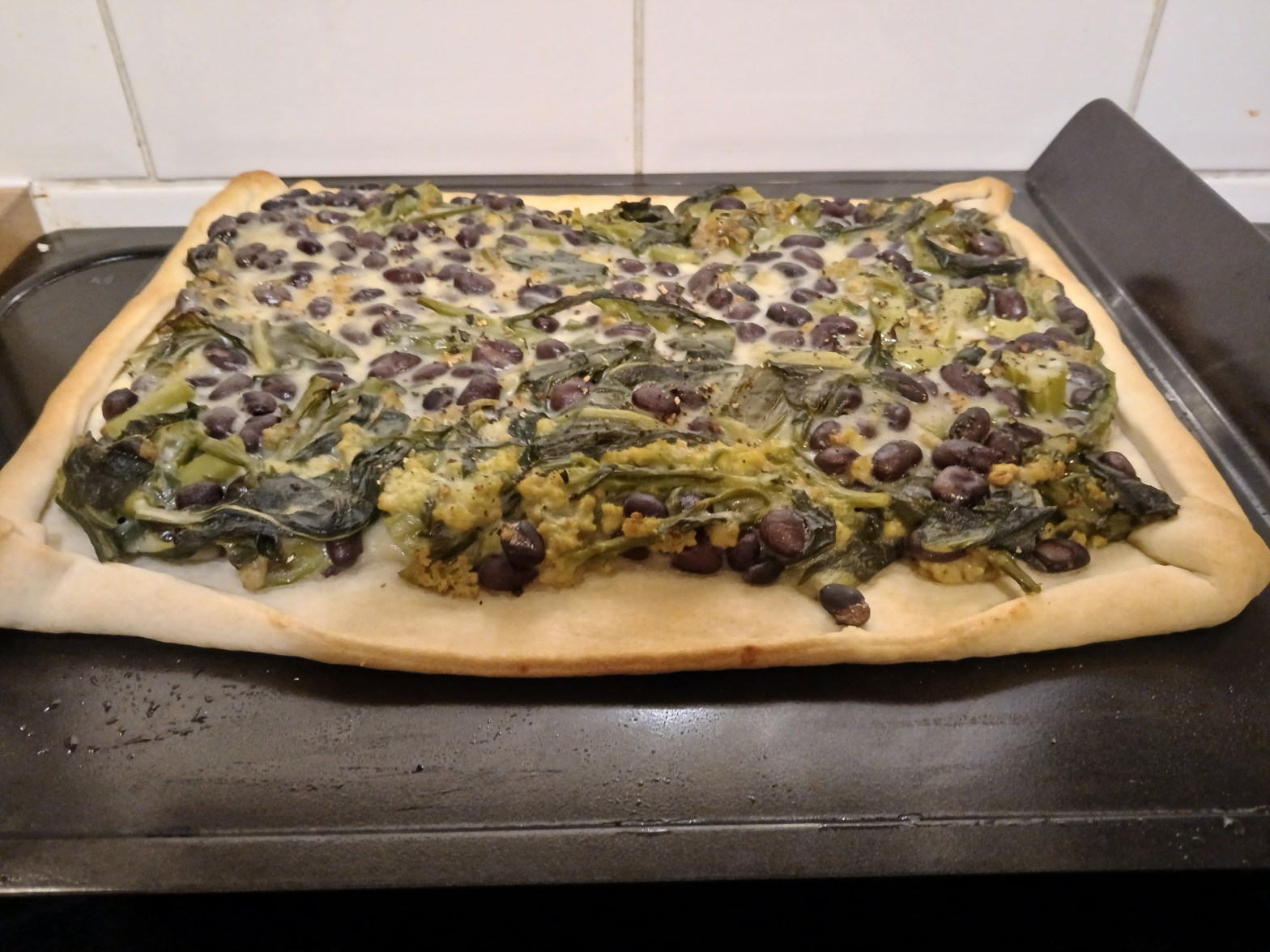
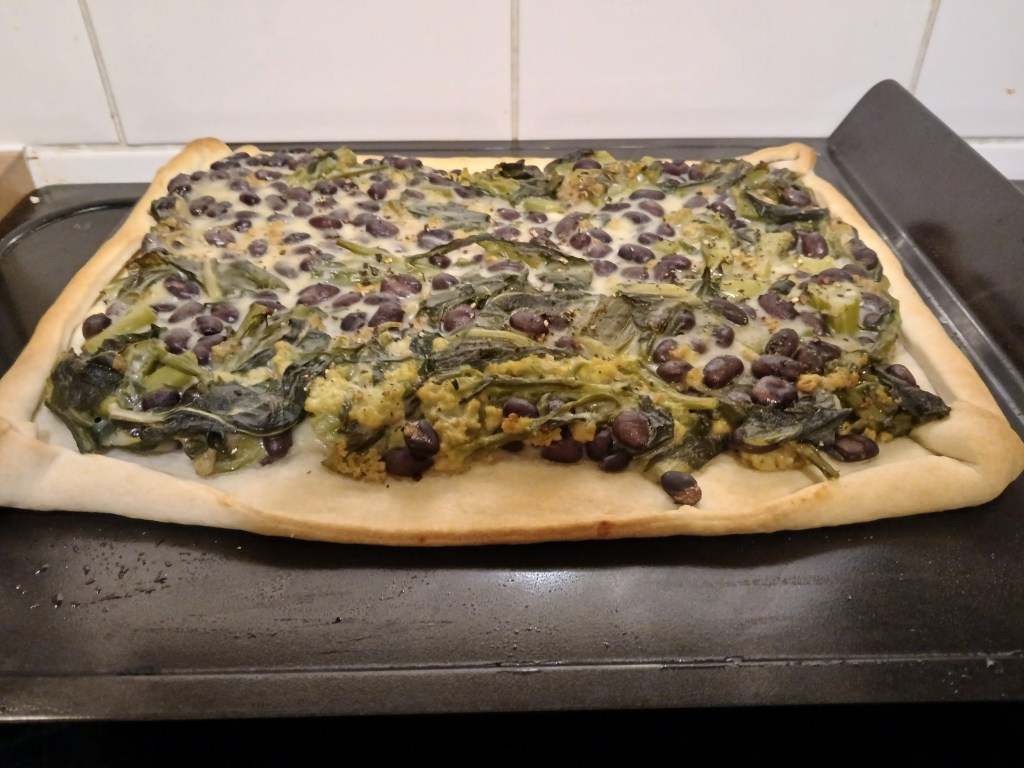
Simple, tasty vegan tart packed full of nutrients, served with your choice of veg.
Prep time: 40 minutes
Serves: 4
For the roux:
40ml oil
40g flour
200ml oat milk
tsp fenugreek, pinch of tarragon, 3 cloves garlic
for the filling:
can of black beans (drained)
200g greens (like kale)
320g pastry
on the side:
small savoy cabbage, shredded
280g green beans
Shred the greens (those to go in the tart) and boil for 10 – 15 minutes. While the greens are cooking, make the roux: Drizzle 40ml of oil into a small saucepan over a medium heat; sprinkle 40g of flour into the oil stirring quickly. Gradually pour the milk into the flour/oil mix, stirringinto a paste each time. The roux should be quite thick. Add the spices and herbs to the roux and stir well. Drain the greens and beans and mix into the roux. Take the roux off the heat. Pre heat the oven to gas mark 7 (as per pastry instructions). Roll the pastry out onto a baking tray. Turn up the edges of the sheet of pastry. Pour the greens ‘n’ beans mix onto the pastry and spread with a knife. Season with salt and pepper. Place tart in the oven for 15minutes, or until pastry is golden brown. Prepare your veg on the side. Serve with a drizzle of cold pressed oil.
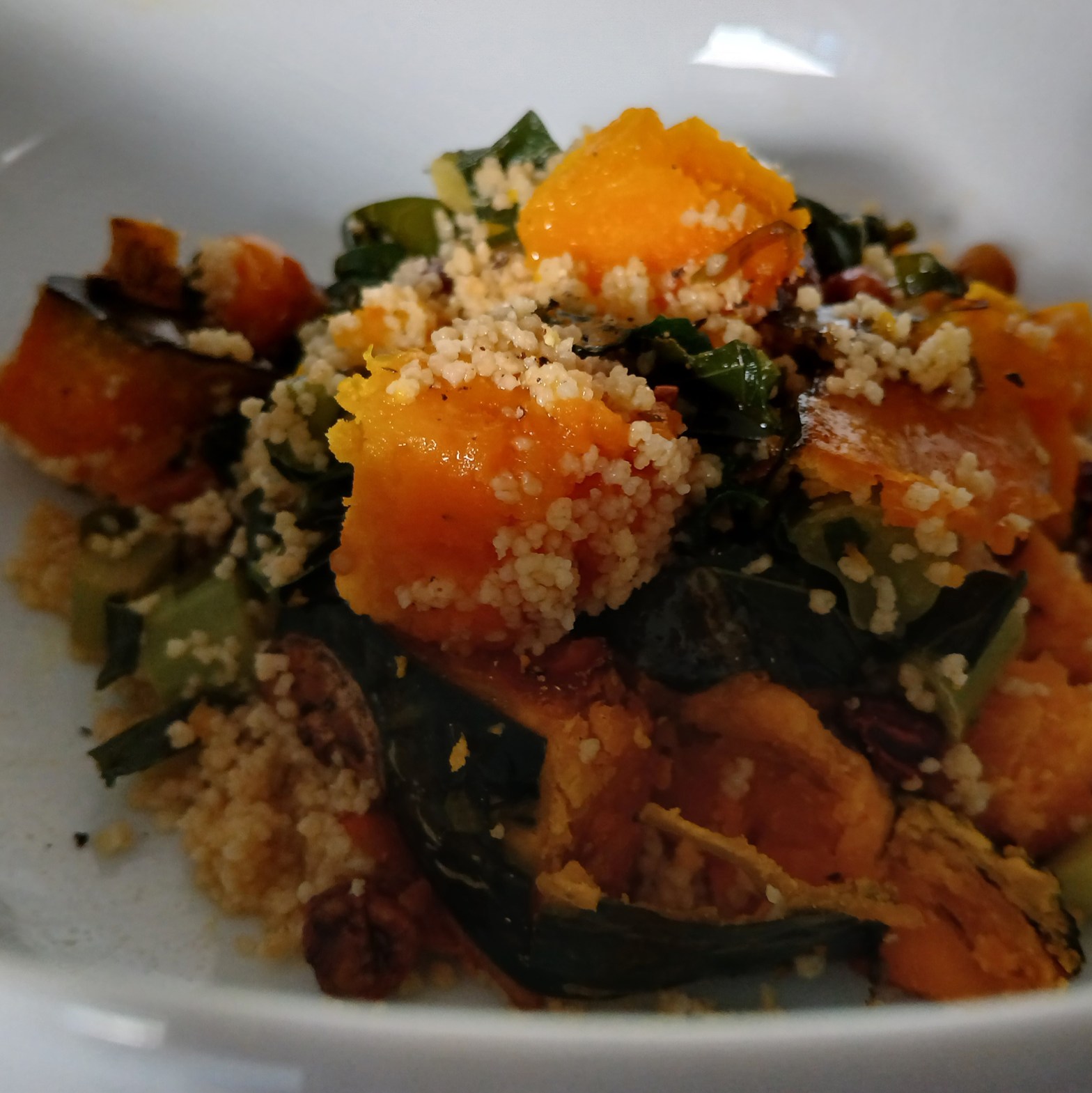
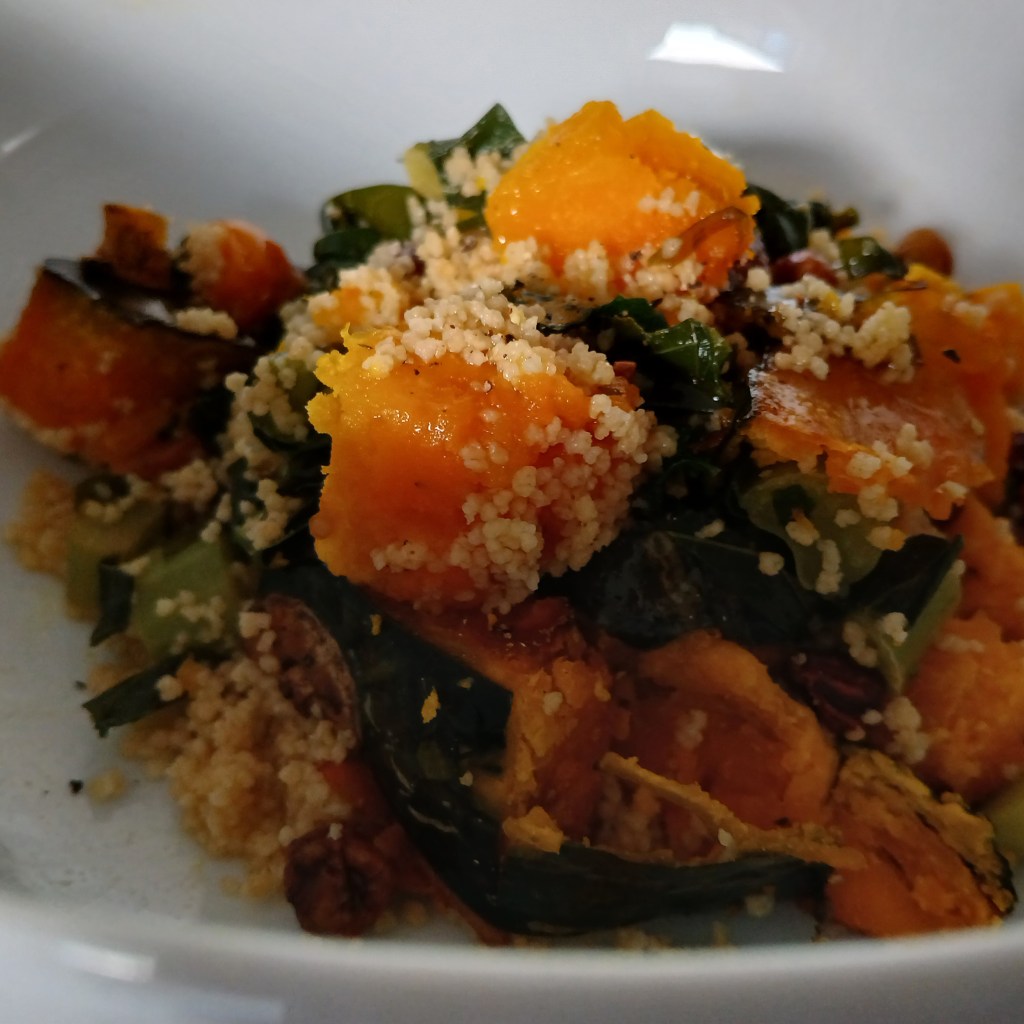
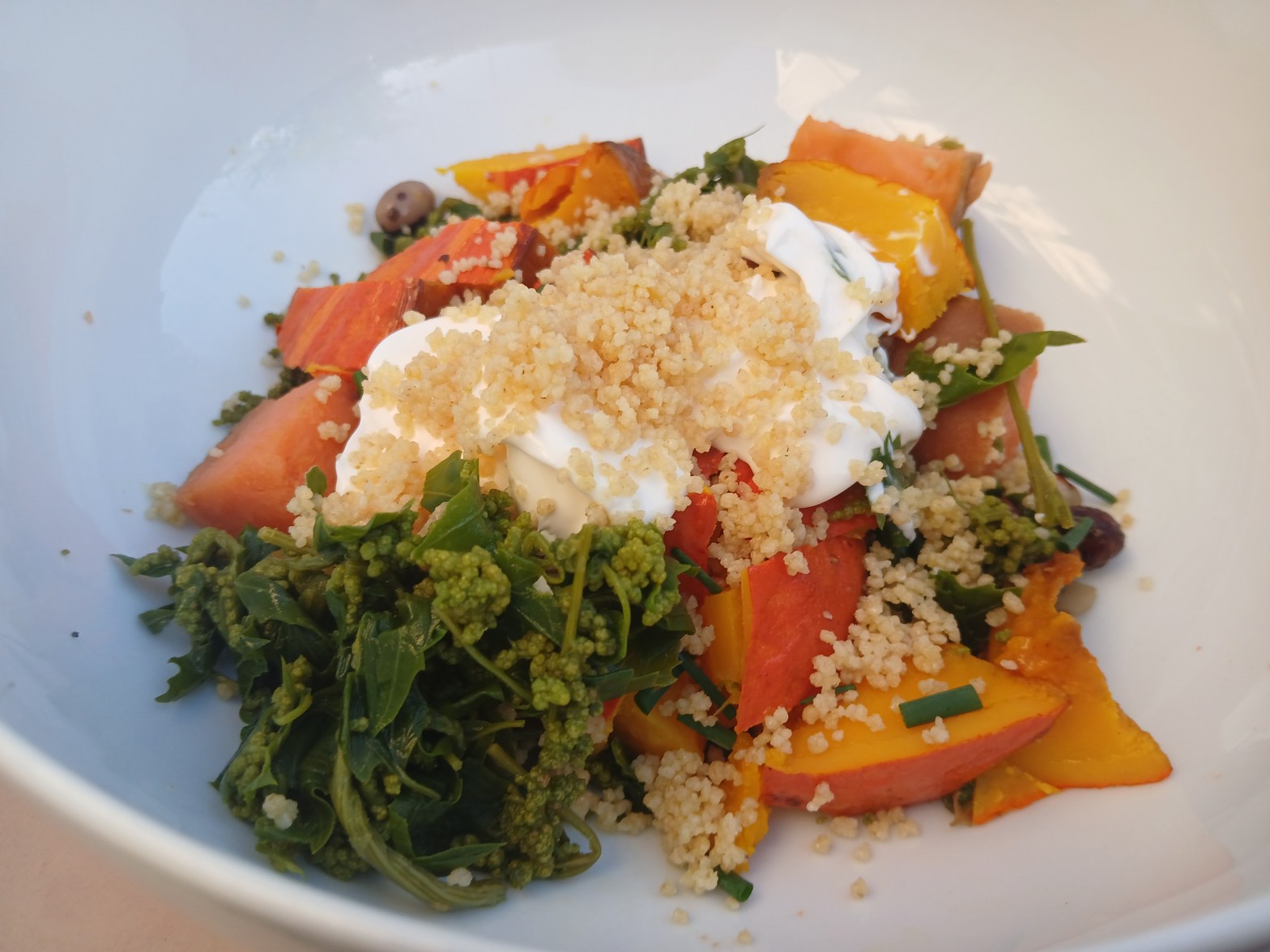
Sweet squash with greens, celery, hazelnuts and cherry tomatoes, well seasoned with fenugreek, tarrgon, parsley and oregano, all mixed together with couscous.
Prep time 45minutes
Serves 4
one small squash
200g greens
50g celery
fenugreek (tsp), tarragon (pinch)
50g cherry tomatoes
4 handfuls of hazelnuts
handful of parsley, sprig oregano
100g couscous
generous drizzle of oil
Pre heat the oven to 200 degrees (fan assisted / gas mark 7). Cut the squash into wedges, place in a roasting dish, drizzle with syrup, and sprinkle with salt and pepper. Place the tray in the oven, on the top shelf and roast for 45minutes. Finely chop greens into 1cm pieces and boil in hot water for 8 – 15 minutes. Warm some oil in a pan. Finely chop the celery and add to the oil. Add the hazelnuts and tomatoes to the celery. Sprinkle fenugreek and tarragon over the vegetables and nuts, stir fry for 10 minutes. Drain the greens and add to the frying pan mixing well. Prepare the couscous in line with the instructions on the packet. When the squash is roasted, take out of the oven and carefully transfer to a chopping board. Chop squash into bite sized cubes. Reheat the greens mixing in the fresh herbs at the end, as they only need two minutes to blend in. Mix the couscous, greens medley and squash in a bowl and serve with a drizzle of oil and extra black pepper.
No Light Ecology searches for the darkness in our light filled efforts to save the world’s ecology. One of the key points is sacrifice. Solutions to climate change, and the biodiversity crisis, are not always in keeping with our modern expectations of cleanliness. Some of the kindest products are in fact a bit icky! I have a wooden soap dish, it is a little difficult to clean entirely, and it is starting to go black around the bottom, but it holds my soap out of the water, so I can easily wash my hands with it. My housemate asked me if I wanted to share her holder as mine looked mouldy. I felt crushed. The trouble is, her holder is made out of some form of plastic; it will shed microplastic every time she uses it. What should I do? Ditch the wooden dish, or persevere until it has degraded beyond use? I think I will buy a ceramic one next time.
The things that we consume, which have the lowest impact, are often things that biodegrade. Things that are impermanent, that do not last for centuries, but instead months or years, are the gentlest to the earth. Let’s take another example: my hemp and rubber yoga mat. It is wearing out quicker than a plastic based foam mat, but it sheds organic matter that will not harm the environment, wherever it ends up. Particles can be hoovered up and end up in landfill, or blown out into nature, into waterways and gardens. I would much rather have a yoga mat that lasts for five or ten years, and then disintegrates into harmless particles, than one that lasts forever and has to be landfilled.
In our modern culture we have been spoilt to the point that we expect everthing to appear perfectly clean. ‘High quality’ goods are associated with sleek, polished surfaces that are often the product of oil based plastics. Good for the short term, say a decade, and then a complete nightmare to dispose of: plastics last for centuries. And when they break down, the particles they release poison animals’ water sources and habitats. The oceans have been filled with plastic rubbish, and also millions of microplastics, which the human eye cannot see. Microplastics come from all oil based plastics, which shed fibres when they are washed, or come into contact with water in some other way.
Slowly, manufacturers are starting to cotton on to what is needed. Wooden spectacles, wooden watches, even wooden technology have made it onto the market. I was excited to discover a wooden toothbrush. Unfortunately, after a few weeks, it started to go black at the handle end. As the upper part was untouched, I continued to use it, but I could imagine that it would put off less accepting customers. We have become so fussy that we are terrified of imperfections. If something starts to biodegrade, we panic and bin it.
Yet another example of things getting a bit icky is composting kitchen waste. When the weather gets warm, fruit flies can make their home in the waste. The trick is to empty the kitchen bin to an outdoor food waste bin every other day, and keep the lid clipped on. I am so enthused to be saving rubbish from landfill that I do not mind a few small flies, but not everyone is the same. There is a disconnect between consuming products, and looking after earth. The more something decays naturally, the less the impact will be on the earth.
The latest trend for forest bathing, where you go out in nature and practice mindfulness under the trees, is one example of how connecting with nature can positively impact wellbeing. The chemical compounds found in soil are said to reduce depression. Not only that, but unwashed vegetables contain the elusive vitamin B12; the soil is where cows get it from. Walking or dancing naked in the forest exposes the skin to healthy bacteria usually stored in the soil, and plant particles drifting through the air. Getting your hands dirty doing some gardening is another way to absorb nature’s mucky gifts.
Many people live under a vaneer of cleanliness. They are so hyper clean in some ways that they have forgotten the simplicity of nature, and its therapeutic muddiness. Whiter than white many people scorn dirt like it is the devil. They prefer to use harsh cleaning chemicals on their clothes, homes and bodies to create a pungent chemical cocktail. In many ways, it is understandable. Cleanliness, or ‘saucha’ in Sanskrit features as one of the observances of yoga: being clean helps to achieve a state of yoga. But just like industrial food, industrial cleaning products slowly poison us and the environment. The scents coming off scented shower gels and fabric softeners are enough to take your nose hairs off. When I was a child, I was embarassed that I did not have such whiffy clothes; my sister had sensitive skin so it was all non bio laundry powder and simple soaps. Now that I am a grown up, I can smell the harshness of the chemical products I once envied, and choose more natural, eco friendly options instead.
Wonky vegetables have been rejected by supermarkets and consumers for appearing ugly. Customers are unwilling to pay for carrots with two sticks, or potatoes with extra bulges. This food goes to waste. Organic food may also suffer more disease, and patches of blight remain on some products, which also go to waste. Modern living in the developed world has eroded our ability to compromise. People are scared to engage with any products that could be considered below par. There is a an expectation that everything is pristine, and anything that is not, is headed for the bin.
Unfortunately, nature itself has been shown the door as our brilliant white lives pollute and destroy the natural world. People who engage more eco friendly options are looked down upon as less clean, and less perfect. We prefer to live amongst the smog of cars, the hum of machines, the invisible beams of mobile and wifi signals, but we shun a bit of dirt on our vegetables, or an unperfumed soap.
To many people, a plastic bottle filled with detergent signifies a source of cleanliness, but the bottle itself is a source of pollution. In our efforts to clean ourselves and our houses, we have poisoned the earth. Carbon dioxide was released when the bottle was made out of oil, and microplastics are released into the waterways every time we use it. Refill shops help reduce the amount of plastic that is used. The same bottles can last for years.
When I lived in Uganda, I was impressed with how clean things were. But of course that cleanliness came from plastic bottles of bleach and bathroom cleaner. When I visited Thailand, the bathrooms were full of toothpaste and mouthwash. All good modern stuff, on the one hand. But on the other, it shows how the message about harsh cleaning products has reached just a slither of the market. Strong chemicals are being produced and packaged on a global scale. The idea that we need to compromise our cleaning and personal hygiene products to reduce the impact that they have on the environment is entirely peripheral.
How do we make a shift towards doing things a bit more icky? Can we undo the cultural binds, the fear of not fitting in, the almost obsessive drive to keep things clean? I am not saying that we stop cleaning, but is there a balance to be made, between cleaning, so that things are spic and span, and respecting nature’s way?
For most situations, where things get a bit icky, a solution can be found that meets both the environmental and functional requirements: a ceramic soap dish, a clip on lid for the compost bin, organic soap and detergents. With a little thought it is possible to overcome the initial ick factor. But there are other examples, like wonky veg and hemp yoga mats, that cannot be compromised; they will be ‘flawed’ forever, and we have to work around it.
The ick factor probably gets in the way of more ecological produce being consumed than any other obstacle. Uncertainty about whether gentler cleaning products really get things clean, will naturally made products last? linger at the back of our minds. No Light Ecology says embrace the uncertainty, commit to trial and error, do your best to weigh up the pros and cons of different products, and invest in the cleanliness of the planet, as much as your home and body. Most of all, don’t be afraid of a little dirt. If things get a bit icky, try a different solution next time, or compromise with what you already have. Just because something biodegrades, does not mean you should throw it out. Do not take unnecessary risks, but at the same time, practice noticing when you are reacting from a place of ‘eew it’s all icky’, and develop a broader tolerance for a wholesome bit of ick.
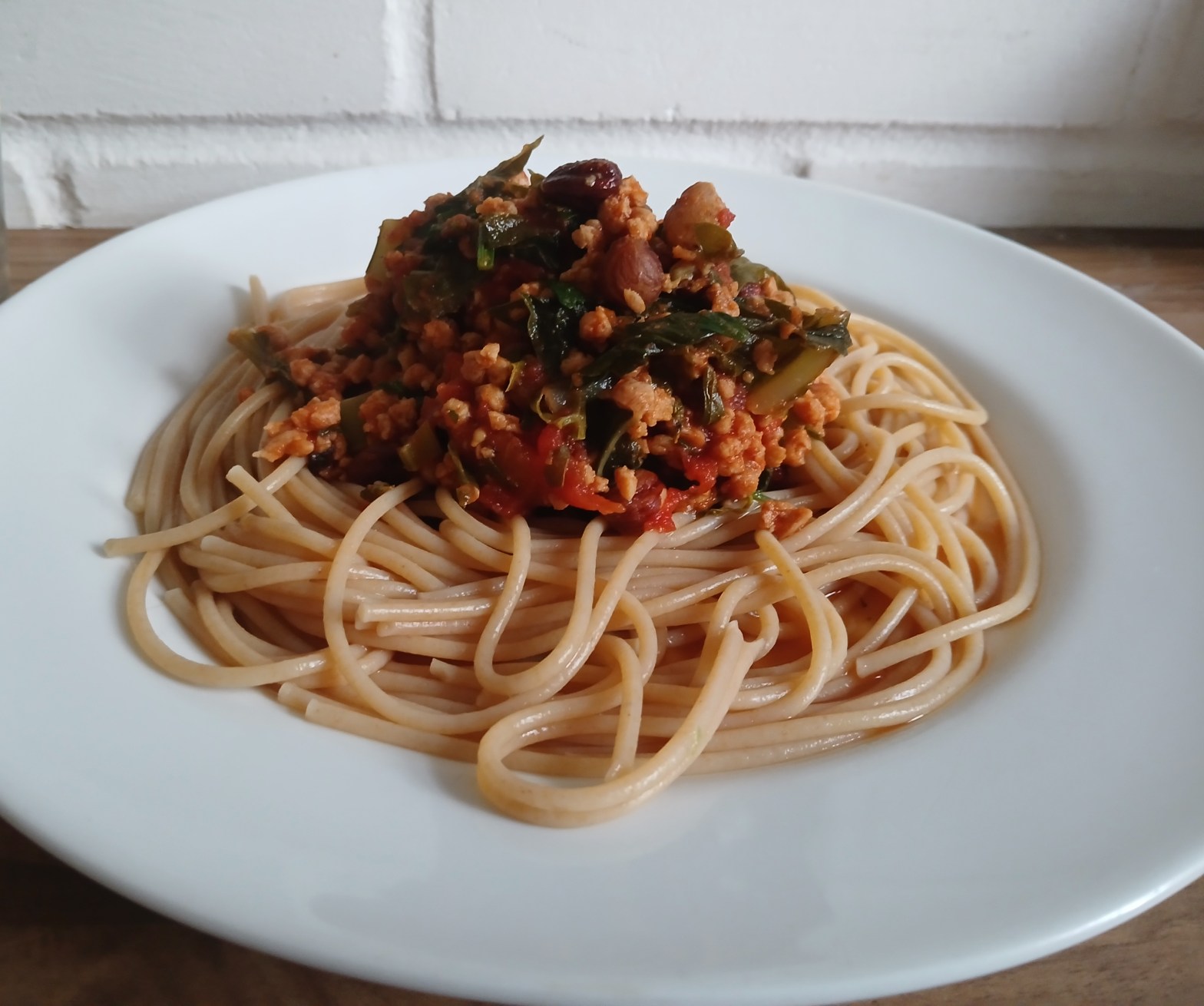
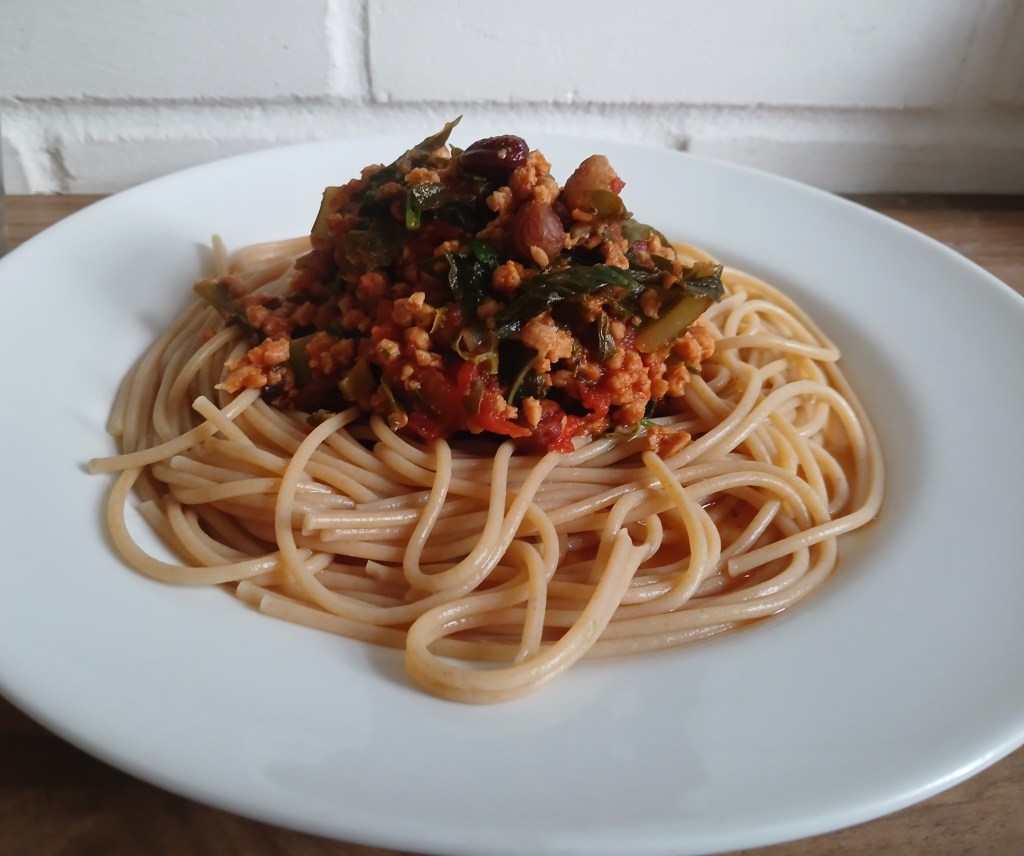
Combining autumn greens with hazelnuts, and celery, this vegan ragu combines the traditional sweet tomato flavour and fresh green herbs, with protein rich soy mince.
Prep time: 1 hr
Serves 4 – 5
200g greens (e.g. kale)
drizzle of oil
bunch of celery
4 handfuls of hazelnuts
tin of tomatoes
200ml boiling water
2 tbsp vegan worcestershire sauce
1 tbsp tomato puree
250g vegan mince
optional: stock cube
handful of fresh green herbs (e.g. parsley, oregano)
wholegrain spaghetti
tahini
Chop the greens into 2cm strips, and boil in a saucepan for 8 – 15 minutes. Drizzle some oil in a saucepan and warm up to a medium heat. Chop the celery into 1cm strips and place in the oil. Add the nuts to the celery. After frying for 5minutes, pour a can of tomatoes over the veg. Add worcestershire sauce, tomato puree, and stock cube. Add the water to the pan and stir well. Add the mince to the sauce and stir. Bring to the boil, then simmer for 15minutes. Drain the green and add to the mix. Simmer for a further 15 minutes. Cook the spaghetti. With 2 minutes to go mix fresh herbs into the ragu. Serve ragu on top of spaghetti with a dollop of tahini.
For those who believe in climate change, the science is simple: gasses released during the extraction and use of fossil fuels are causing the planet to heat up. Carbon dioxide, methane, and nitrous oxide, exist naturally in the earth’s atmosphere, and reflect sunlight back to earth. Historically, the atmosphere has helped to create a stable land temperature. That balance is being disturbed. The more we drive petrol powered cars, eat lots of meat and use coal and gas to heat our homes, the more of these gasses we release into the atmosphere. More gasses means more heat reflected back to earth, which means higher temperatures.
Some people still do not believe in climate change. For some reason the scientific reasoning evades them. Science fiction does not help. Apocalyptic representations of the future where we have technologised even further, were scrap metal junk yards become the scenes of battle, skew our appreciation of what is possible. Data cantres, largely driven by AI, are predicted to use twice as much energy as they currently use by 2030, equivalent to the electricity consumption of Japan. Cryptocurrency uses as much energy as Norway, and continues to grow.
In a world that has been fighting climate change for decades, these new technologies are pulling us in the opposite direction. Although data centre consumption is only projected to be 4% of the global total, energy consumption by sector is made up of a long list of fractions of a per cent, so 4% is actually quite a lot. Symbolically, growth in these areas signifies a culture that does not want to prioritise nature, that does not, or can not wait for clean energy.
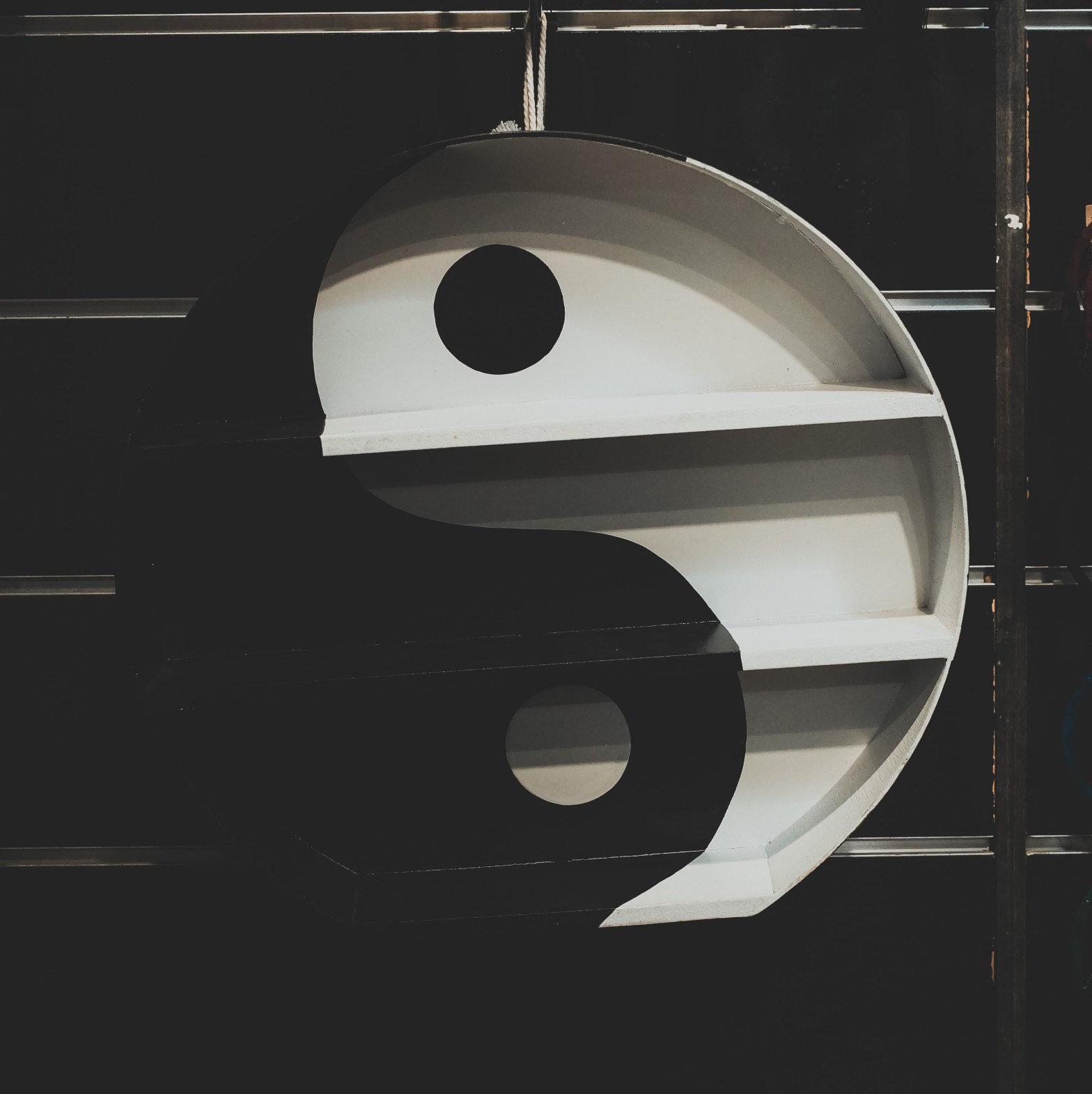
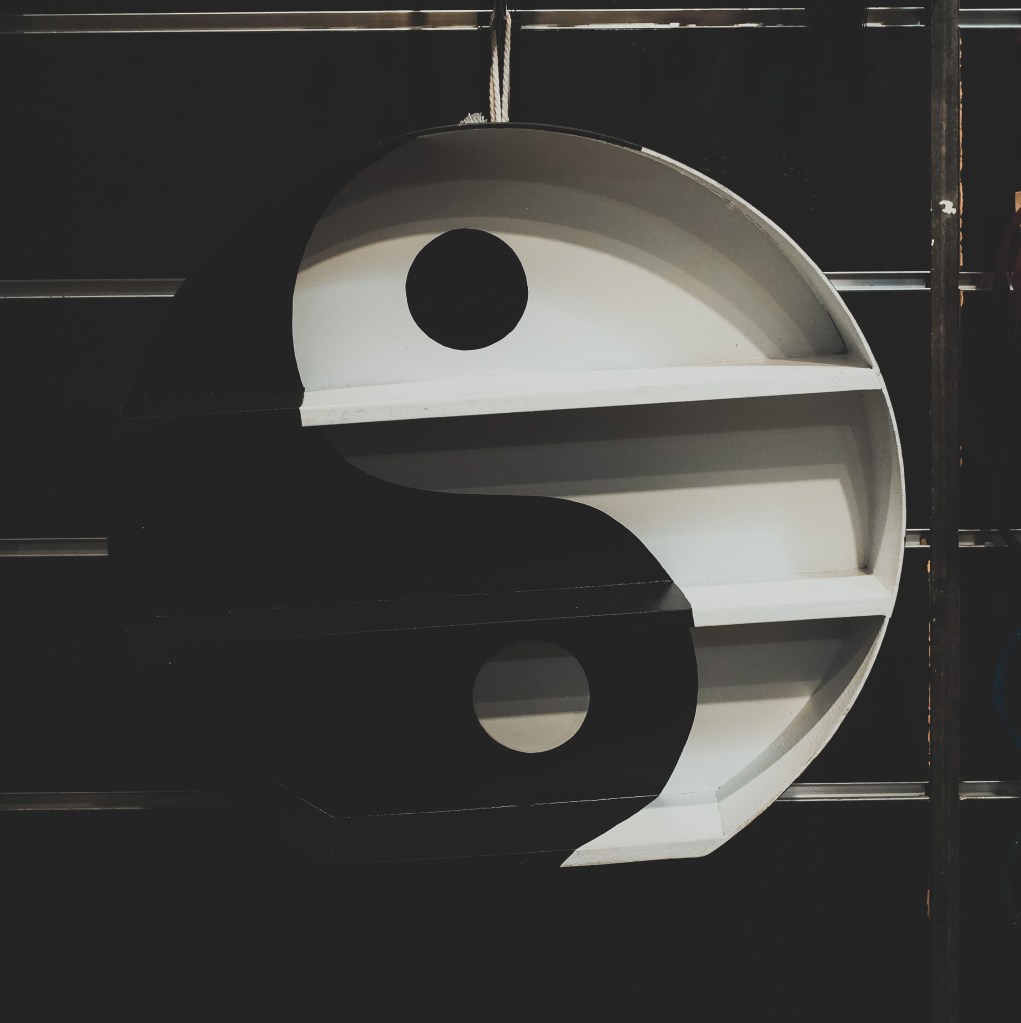
In a way, we cannot expect everyone to understand climate change. 100% of people believing the same thing is impossible, our spiritual climate forbids it. The philosophy of yin and yang is such that as soon as soon as one group of people believe one thing, another will believe another. But isn’t climate change so important that it falls outside of the scope of yin and yang? You could say that believing in healthy ecology is like believing in the need for fresh water to drink, or healthy food to eat. Do we not need a healthy atmosphere to live and breathe? In recent times, even those things evade us. We are polluting our water, and poisoning our food. Nothing is beyond the cosmic force of balance; industrialisation has come at a cost.
The ancient philosophy of opposites is in operation at all times. Overcoming these contradictions is the human experience. Growing up, I used to believe that everyone should be a socialist. Then in my twenties, I discovered yoga and I believed everyone should be a yogi. But as I got older, I realised that this was an immature, simplistic way to look at things. Like the natural world, with its thousands of plants and animals, we are a diverse people. Expecting everyone to believe the same thing is energetically impossible; we should be curious about the diversity that we live in, not struggling for unity.
This is easier said than done. It seems to be our human condition to try to improve our lot. Utopic thinking is an easy trap to fall into. But unlike issues such as inequality and health, which bring about much suffering, our ecology threatens the survival of the entire human race. Systemic change is urgently needed to avert a crisis. We need to prioritise ecology and to bring down carbon emissions.
I worry that populism is an unconscious reaction against the environmental movement. No Light Ecology aims to minimise the light released by our ecological efforts. We need to target those groups in power who have the influence to change industry, and consumers need to change their buying patterns too. But can we do it without a great shift in energy? Spreading knowledge about the climate could be considered enlightening. But in some ways it is in the shadow of the climate emergency. Does the urgency of the problem overshadow the light of truth that talking about climate brings? Does true awakening come with its own cost? Climate doom, a kind of depression has been reported in the press, as more people become aware of the potential apocalypse we face.
If we can move more towards right brain thinking, which processes our emotional wellbeing, rather than our left brain thinking, which brings rational, logical, linear thought patterns, we open up the opportunity to feel the plight of earth, and to appreciate that we face danger by consuming so much. If we remain in predominantly left brain thinking, we may fail to feel the emotional, unconscious connection between what we do with our time, and the effect we have on earth. Whilst left brain logics should reveal that greenhouse gasses equal atmospheric pollution, equals climate change, we need emotional maturity to process the enormous significance that such truth holds. If something is too big to process, we tend to ignore it, or feel overwhelmed by it.
Right brain thinking also encourages us to create, rather than consume. We connect more with our surroundings, taking inspiration from the things around us. By meditating, practicing healing arts like yoga and singing, we can develop our right brain. When we achieve greater balance, we seek joy and connection, we grow in mindfulness and achieve deeper relationships. It is not all sweetness and light. By engaging with the right brain, we come across our shadow side, and even trauma. In order to create and connect to our hearts, we sometimes have to accept difficult truths. Life can be hard. It is no wonder that we hide in our rational brains.
Technology panders to our shadow side. We hide away, we bury our heads in the sand. Instead of spending time in nature, we watch TV, instead of making music, we collect CDs, instead of baking, we buy processed cakes, instead of growing food, we go to the supermarket, instead of playing sports we watch them, instead of acting in a play we watch soap operas. That subtle distinction between creating and consuming has transformed society, community has broken down, nature has degenerated.
In a world of opposites we cannot expect everyone to understand climate change. But we need to reach critical mass, where enough people believe in it to create change. Changes to our consumption patterns where we only buy recycled or biodegradable goods; where we walk or cycle instead of driving; where we buy organic instead of conventional produce. Once infrastructure has been improved, and once prices have come down, more people are likely to engage new behaviour patterns for both climate, and for reasons other than climate.
In reality, not everyone is going to believe in climate change. Even though it is backed up by science, it is still a belief that people choose to believe in, or not. The gasses are invisible, the weather from year to year is difficult to remember: for people who cannot follow the science, or do not trust authority, climate change is nebulous. Do not panic. This fragmentation of society is normal. In fact, it cannot be any other way. In a world of opposites we need to get used to living amongst a range of viewpoints. Critical mass is a fraction of the whole. Although it is difficult not to despair, do not be discouraged when you meet people who do not believe in climate change. In a world of opposites, it is extremely unlikely that everyone will ever unite.
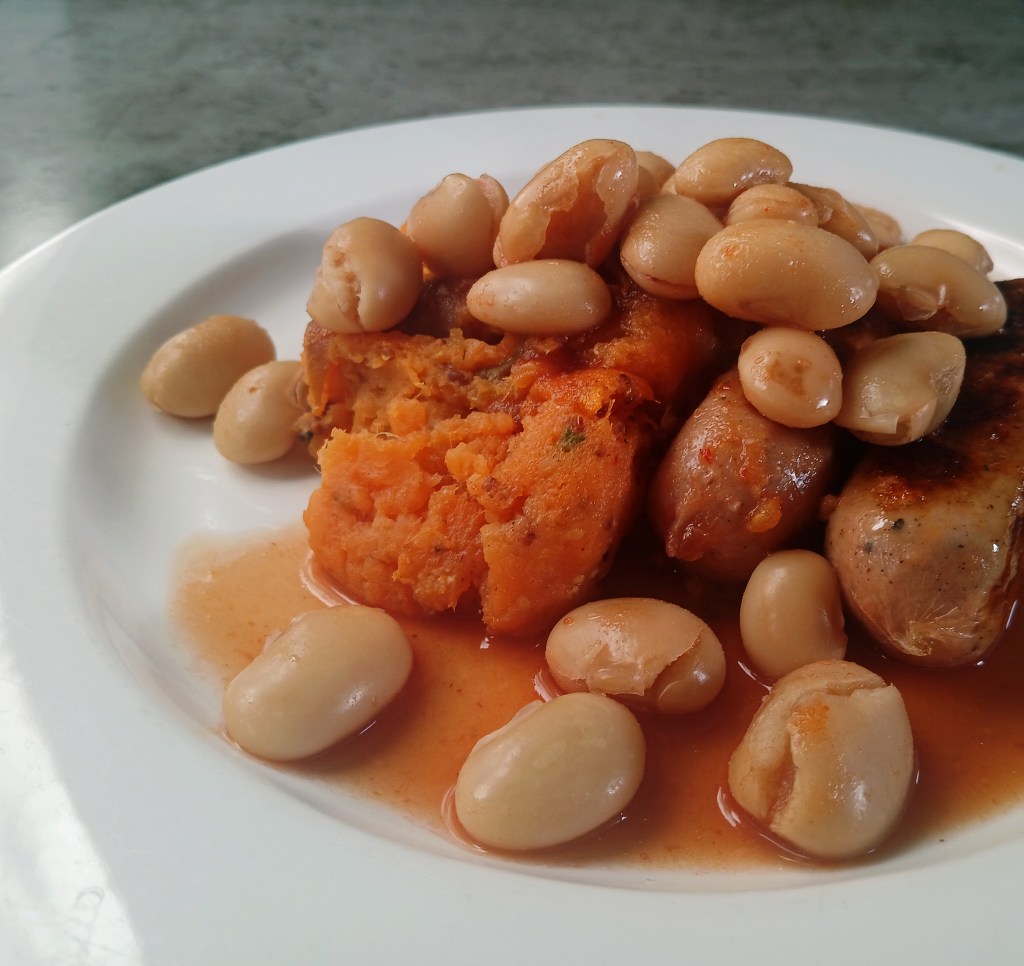
Whipped up from leftovers when I had nothing else left in the cupboard, these butter beans make a giant change from baked beans. Reinvisioning the classic dish of bangers and mash, with vegan sausages and sweet potato mash.
Prep time: 25 minutes
Serves 3
Can of butter beans
1 tbsp tomato puree
½ teasp garlic puree
2 tbsp vegan worcestershire sauce
200ml water
300g (sweet) potatoes
1 ½ teasp wholegrain mustard
6 vegan sasuages
Chop, then boil the potatoes for 20 minutes, or until cooked. Fry your favorite plant based sausages in a little oil according to the instructions. Mix the tomato puree, garlic puree and worcestershire sauce in a ramikin with a small whisk, or a fork. Drain the butter beans and place in a saucepan with the tomato sauce. Simmer beans for 10 minutes. When the potatoes are cooked, drain and mash adding mustard to the mix. Serve all together.
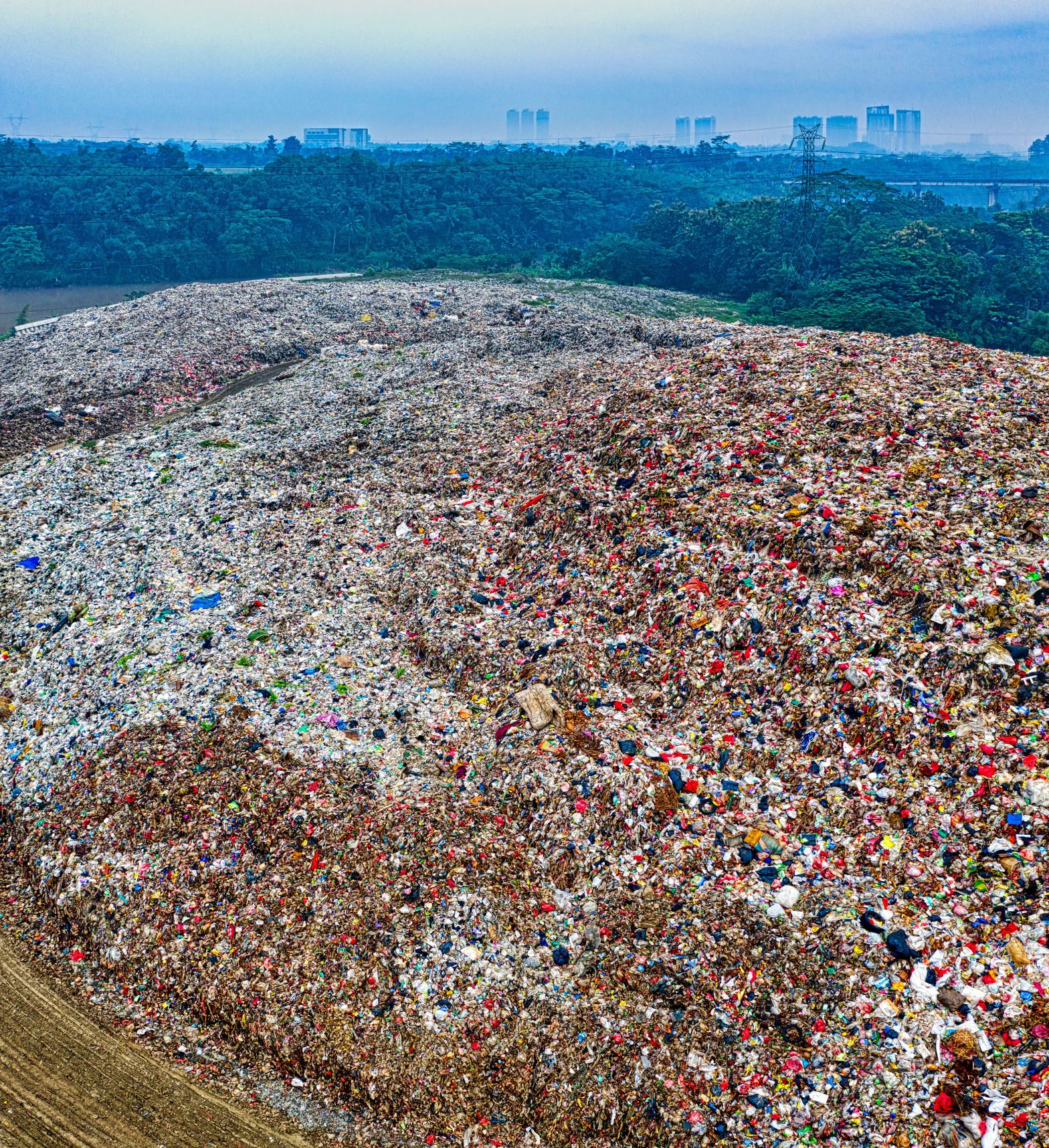
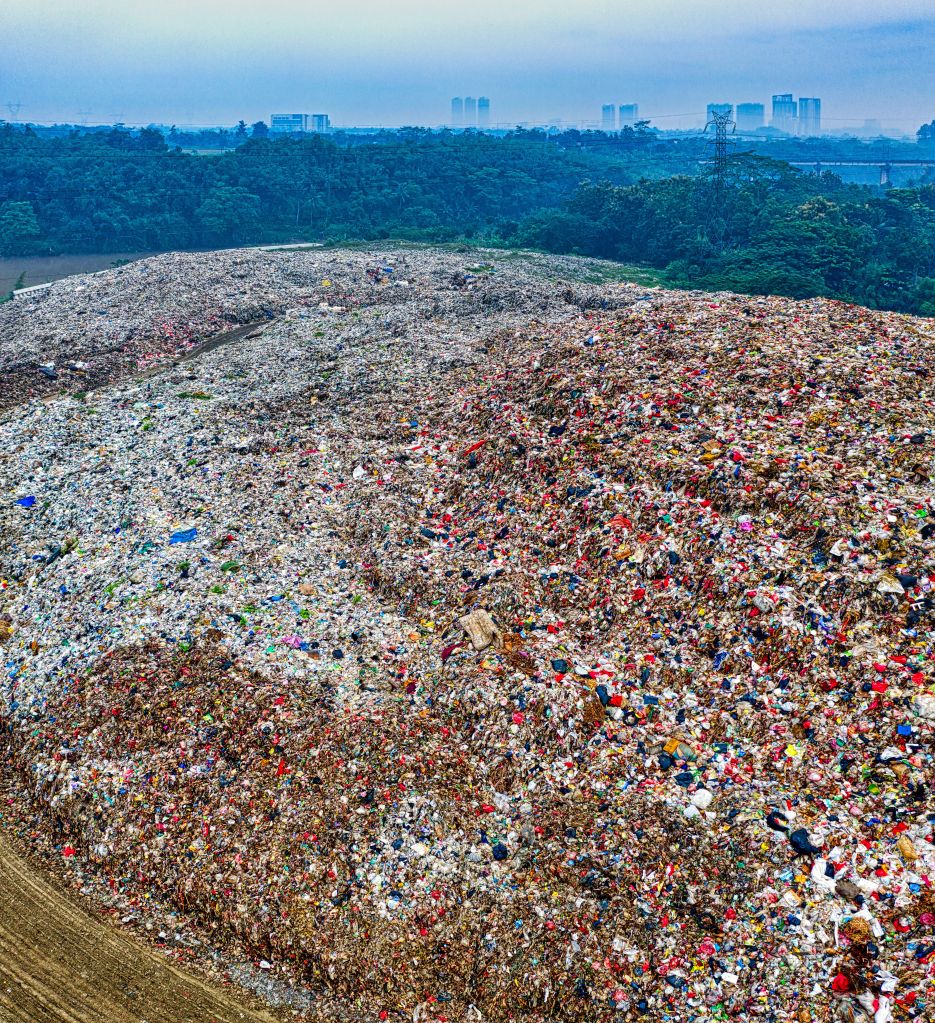
Every week, I put a wheelie bin containing the household rubbish out in front of the house. Some weeks it is full. I imagine where the rubbish will go. I see rubbish piles the size of houses, for every household, grow over the years. The word ‘landfill’ keeps things nice and tidy, but in reality the sprawling mass of discarded waste, with a stench to match, is beyond comprehension.
By contrast, I once stayed in a spiritual community in India. There were no rubbish bins there. Every littlepiece of rubbish was reused or recycled. The sheer challenge of discarding anything meant that you were much more careful about what you consumed. Nobody used plastic carrier bags. Kitchen waste was composted. Recyclables were separated. There was a culture of preserving the land, and protecting it from human destruction.
The garbage culture here in the UK is one that has forgotten nature. In the process of developing, over the past five millennia, since urbanisation, we have become habitualised to throwing our rubbish away. ‘Away from here’, ‘out of sight, out of mind’, ‘far, far away’. In reality, away does not exist. There is no away. On landfill sites, nature has gone, waterways are poisoned, the air is polluted. And these sites are only getting bigger.
We have slowed down our rubbish disposal with recycling. The good news is that more waste is being recycled than ever before. But we need to do more. Just a few minutes more each day separating waste could result in more waste being recycled.
The mantra reduce-reuse-recycle is handy in remembering the order of waste reduction. Foremost, we need to reduce what we cosume, secondly, we reuse what we have aready consumed, and thirdly, we recycle what we have consumed, rather than throw it away. Having somewhere to store bags, scrap paper, elastic bands etc can be useful, as well as reducing your consumption. Used envelopes can be cut into notepaper for shopping lists and the windows that you get in envelopes can be recycled at the supermarket thin plastics recycling bins. Food containers may need a wash before they can be recycled, just put them through at the end of the washing up. When you leave the house, take a canvas bag to avoid using any plastic bags (reduce). Or, secondly, reuse old plastic bags. Take old shoes and clothes to charity shops. Do your clothes shopping at preloved shops like Vinted or Depop (reuse). Or ask yourself, do I really need to buy something new (reduce)? The number of measures that we can take to reduce our rubbish are endless.
Plastics
The waste that we produce is not limited to what we put in black sacks. Every time we wash something plastic, we release microplastics into the water supply. Thousands of plastics shreds litter our water supplies. Personally, I worry that my biggest contributor to plastic waste is plastic tupperware. I always batch cook, so tupperware is an important part of my routine. I wash them every few days. Ideally they would be made from plant based plastics. Many plant based plastics biodegrade. Once they are released into the waterways they dissolve into sediment, and provide organic matter for the river bed. But these products are still not on the market. I have replaced my green sponge scourer with a coir sponge, a form of plant based produce, so I can rest easy about that, but my washing up bowl is still conventional plastic.
Choosing non plastic solutions, or when to use recycled plastic and when to use plant based plastic also takes a little thinking. Things that get washed regularly, or come into contact with liquid, like shampoo bottles and clothes, should be made with plant based plastic, unless they can be made with other types of plant based fibres. Things that we do not wash often, like drawers, trays, stationery, bins can be made with recycled plastics. There is a lot of recycled plastic, which is fantastic, but it needs to be directed towards products that do not have much contact with the water supply i.e. that is not washed very often.
Compost
The amount you can compost, and return to the earth in the form of soil, is surprising. Gardeners are probably already familiar with what you can and cannot compost. The biggest item of waste that is compostable is humanure, but, sadly, few people are in a position to recycle their toilet waste. Kitchen waste can be composted and applied to condition the soil in the garden. Food waste can also be turned into biogas. There is a debate about which is more ecological, but both are better than landfill. If you have your own compost heap you can include more things than the municipal collection food waste. Things like old cotton socks, paper tissues, hairbrush hair and nail clippings, floor sweepings, dust, full vacum cleaner bags, shredded bank statements, anything that is made of organic matter and biodegrades in the space of a few months.
One thing to consider when making decisions about what to consume is the conflict of interest between carbon counting, and averting biodiversity loss. Plastic bags have a surprisingly low carbon cost compared to paper carrier bags. But when it comes to biodiversity, the plastic bags are seriously damaging to the environment, compared to the paper bags, which come from trees and decompose quickly. The result is that an organic cotton canvas bag that lasts for years is the superior option, and they can look cool too. When it is worn out, after hundreds of uses, add it to the compost bin. It is important to consider both carbon emissions and the impact on biodiversity. There’s no point averting climate change if there’s no natural world left. Nature feeds us by pollinating our plants, providing clean water and air to breathe, and replenishing our soils through decaying animals. When our biodoversity breaks down, we lose all those things.
Lessons in the shower
I was having a shower yesterday, and as usual, at the end I wash my hair. There are lots of bubbles on my head and I decide that I also need to shave my legs. So I take some bubbles from my hair and put them on my legs. I am probably saving half a day’s worth of soap. It does not seem like very much in the grand scheme of things, but crunching the numbers gives a figure of 15% less soap. But is it really worth it? I do it because I hate wasting soap. I am pisces, so I think I may have an affinity for the fish in the rivers and oceans. I don’t want to poison their home more than I have to.
Reducing consumption by fractions here and there is difficult to appreciate. It can turn reduce-reuse-recycle into a real chore. No Light Ecology recognises that when we take the three Rs to their furthest point we stop feeling light filled and become slightly tired. We need to spot savings in our daily routine as much as possible, but it becomes an effort, the more we do it. Attending to the minutiae in our daily routines goes against the grain of modern progress. Modernity believes we should be free to waste; it is the price of convenience. With mainstream culture engrained with this kind of laziness, will we be able to tackle the minutiae en masse? Will most people think I’m crazy to reuse my shampoo foam?
I have experienced a few like minded people in my life. The spiritual communty in India, where I lived in a tree house was one of them. I didn’t wear shoes and I showered out amongst the trees. I was physically and mentally connected with the earth. There was no room for rubbish, or waste of any kind. There are no dustbins in the jungle. Out in the forest there was a culture of sorting every last piece of rubbish, however small. It took some getting used to as it used a new part of my brain, but after a while it became habitual, I knew where most things went and I had cut out things I could not recycle.
The second place I learned that it was ok to think about the minutiae was from my grandmother. She lived ‘up north’ so I didn’t get to see her very often but when I visited her house as a child I noticed that she had a set of tiered boxes by the back door. In each box was a different item to be recycled. This was in the 1990s, so we had only just started taking our glass bottles to the bottle bank down south. But here was my grandma separating tea bags, from plastic, from paper. Each and every tea bag that she used was saved from landfill, presumably composted.
To many people, this process of sorting rubbish is too much to ask, to them it is literally a load of rubbish. Even broadly sorting rubbish into recycling and waste is too much for many people. I guess it is because they cannot process the damage that every little bit of waste does, how bigger land fill sites means less land for wildlife, and how relatively easy recycling is in preventing land fill. Plastic trays, cardboard wrappers, however big or small they are, it helps if they make it into the recycling bin rather than going to landfill. If you can find someone with a compost heap, you can even save your food waste, that’s if your council does not already collect it. Use the thin plastics hubs at the supermarkets, put everything you can into recycling. Set yourself the challenge of throwing nothing away. Keep your eye on the waste bin and see how long you can make a rubbish bag last.
The more you do it, the more it becomes habit. Even though it is not always easy to process, ‘can this be reused or recycled?’ it is an effort that aims to reintegrate the dark energy of consumption with the consumer. Protecting ecology from suffering due to industrialisation (see previous posts) can only be achieved by some level of caretaking, and effort, on the consumer side. By sacrificing some of our modern freedoms, can we shift the balance and help protect nature in the face of industrialisation?
Summer is fading fast, but I couldn’t resist this potato salad full of seasonal delights like squash and hazelnuts. Always a classic growing up, potatoes wrapped in mayo, with chives from the garden was served cold with salad.
500g squash, chopped, 1”pieces
80g hazelnuts
2 large sweet potatoes, chopped, 1”pieces
200g greens (e.g. spinach)
200g couscous
can of beans (you choose!)
handful of chives
lots of mayo
Roast the squash and hazelnuts drizzled in syrup and oil at 200 degrees (gas mark 7) for 40 minutes. While they are cooking chop the potatoes and boil in a saucepan for 20 minutes. In a separate pan, boil the greens. Prepare the couscous in line with instructions. Drain the beans. Once cooked, put the ingredients into a big bowl. Roughly eight dollops of mayo should give everything a nice smattering. Snip the chives with scissors into 1cm pieces directly into the bowl. Mix together thoroughly.
In the nineteenth century, a movement arose that would cause more revolutions than any other ideology in history: communism. Capitalism, its antithesis, had been brewing for some millennia, but with the advent of industrial solutions, the downsides of capitalism such as environmental destruction, and inequality, spiralled out of control. Industrial capitalism would result in international corporations and individuals earning more than entire countries, Marx prophesied, and he was right. In a nutshell, he argued, the proletarian was exploited by the capital owning bourgeoisie, who could make lots of money, using the money they already had. In response to this, the proletariats formed trade unions, and the labour party emerged.
In very simplistic terms, global industrial capitalism created such gross inequalities that communism emerged, espousing equality, to balance out individualistic capitalism. The well meaning, greatly misuderstood, ideology of commuism was too utopian to ever come true, but it has left its mark on global politics. Votes for the masses, state schools, a minimum wage all have their roots in the age of socialism. These measures, to name a but a few, tempered capitalism so that it would become more sustainable, serving everyone, not just the rich.
The light of industrial innovation was met with the darkenss of inequality; that was met with the lightness of hope and political activism: an evolution of ideas turning from light to dark and then back again in an infinite play of yin and yang.
You could say that less action has been taken with regards to the environment. Over the last century, new chemical solutions have been released onto the market, plastics have become everyday essentials, petrol powered cars are widespread, resource heavy computers and mobile phones have burgeoned, all influencing life around the world. Industrialisation has had such an awesome impact, the word industrialisation does not do it justice. The cumbersome, seven syllable term reminds me of a blackened steam train chugging along as someone feeds coal into the engine, poop poop. Manufacturing and consumption, two sides of the same coin, feed on indutrialisation. Factories, machines, transport networks all depend on energy, but they come with a high ecological price tag.
Unlike the working classes, the earth does not have a voice to speak out. All its rivers have been polluted, many trees have been cut down, the soils are degraded, the wildlife is dying out. But it has no representation in government, or in the law courts. The earth is the biggest giver, but it has no rights.
Science fiction predicts the rise of machines to the exent that flying cars will fill our skies, space travel that takes decades, or even centuries, will become the norm, walking, talking robots will live alongside us in our homes. All of these inventions take resources, and energy. We are already at breaking point with climate change threatening to take us over the brink of survival. Can we afford another wave of unfettered innovation and industrialisation?
Bladerunner depicts a planet in permanent darkness, and rain, but the reality could be much worse. As the planet heats up, infrastructure breaks down, agriculture suffers, eco zones deteriorate, creating negative feedback loops where the planet only gets hotter. At 50 degrees humans die, plants die; there is no life on earth. Will we breach this climate change limit?
How many years we have left is uncertain. What is needed is a positive representation of the future: tree lined avenues, white electric cars, clean waterways, trans national cycle pathways, plant based plastics, low waste solutions, improved reycling, ecocentric decision making, and the development of thousands of substitute products. Instead of using our energy to develop new products we need to redevelop the old ones. We need to redirect the light inherent in our current products and create new offerings that we can indulge in, but without the ecological cost.
The steam train of industrialisation represents the insatiable quest for betterment that afflicts the human race. And why not? What were we put here on earth to do, after all? I like trains. But we have reached a fairly unique point in history, where if we do not act in the interests of the earth and its ecosystems, we will self destruct. The train must be stopped and cleaned up. What we know about ecology is that it cannot withstand polluting industries. These should be left behind while eco friendly innovations go full steam ahead.
Just as communism challenged capitalism, to provide for the poor, to give the working classes a political voice, a form of ecology is needed that will challenge industrialisation. An economy based on mainstream eco-solutions, rather than niche green products; a philosophical breakthrough at board rooms across the country; where the death of nature resonates with product developers; where polluting products do not even make it onto the market.
Industrialisation does indeed look like an unstoppable steam train chugging along fixed lines of ‘progress’. The earth needs us to rethink what progress means. Instead of draining the earth, we need product lines that integrate with earth’s ecosystems. Instead of more IT and space travel we need biodegradable goods, and packaging; renewable energy sources; organic food and clothes; gentler soaps and detergents.
Until we have discovered a clean energy source, energy intensive projects like space exploration, and even AI, should be put on a back burner. The government should use the climate emergency to communicate responsible patterns of consumption. Have you switched to a renewable energy supplier? Have you considered an ecological washing detergent?
No Light Ecology recognises that the loss of nature is the darkness that underlies the light of modern progress thanks to industrialisation. It is a largely unconscious exchange. But time is running out. Ecology is not about fantastical lands; it is about restoring what was given to us. Without them we will die. The balance between the darkness of losing nature and the light of technological progress is a trade off that is no longer feasible. So much of what we consume comes from resources in the ground. Along productions lines, we release chemicals into the waterways. And the final product becomes waste destined for landfill. There is much darkness underlying the light of modernity, but we do not see the connection.
Let’s consider an example. Super clean, most of us wash everyday, we apply different toiletries, we wear clean clothes. We are bathing in the glorious light of cleanliness, and most of us would not dare to change it, that is if we are even aware of it. But we release chemicals into the drains and we dispose of our empty toiletries in the bin, perhaps they are recycled. We have become used to being so clean, and have forgotten the ecological cost.
How do we reclaim the rights of earth without upsetting our routine? Is it even possible? It is possible to change things up. I wash using an organic soap bar, so no plastic shower gel bottles. My toothbrush is made from plant based plastic, so it goes on the compost pile. My deoderant is refillable. Micro measures that adopted by 8 billion people would make a real impact. But there is still waste, there is still some pollution.
Few of us think about the energy underlying our everyday habits. As we have developed more and more material goods, the feelings of lightness that they create has been sidelined for a more physical, bodily appreciation. But even that is largely unconscious. So what, I am clean, my house is clean, I eat well, I wear nice clothes, I drive a nice car, etc, etc? We have gained so much over the last centuries, but it has quickly become the norm. I try to be mindful, but it is easy to forget to be grateful for the simple things in life. And as well as gratitude, perhaps we should be cultivating a kind of recognition; a deeper respect for what the earth has sacrificed. No Light Ecology helps me remember the cost of what I consume, even of my organic produce. In recent times, nature has largely borne the energetic cost of our material development. As we shine, nature dies.
What happens if we disconnect, or decouple, that relationship? If we no longer let our unconscious drive the equilibrium that sees nature losing out? Can we rescue nature from our greed? Humans like to consume things, it is in our nature, but can we change what we do and protect the natural world at the same time?
We are drawn to the light. But light attracts dark. Even as we pull towards the light of ecology, some darkness remains. We cannot eliminate our footprint entirely. Maybe this is a strength? There is an element of darkness in all that we consume. Before we lost our connection to earth, we would cherish it, sometimes meditate with it. This habit of honouring and appreciating the earth’s giving would enable us to see the darkness that we release with every step that we take. Just taking clean water from the tap is an act of receiving from the land. That water has travelled from the rivers where fishes once lived; we have taken from nature. By energising on what we take from earth, even when we use eco-produce, we are able to see that we are not perfect, we are not expecting to create a utopia, we are still taking from the planet in many ways.
Meditating on, or just spending a few moments appreciating the darkness inherent in the light could change the energetic dynamic of consumption. Instead of obliterating nature, we take from it sparingly, knowing that it has to be sustained for future generations. Few eco products are 100% natural. As we indulge in getting clean every morning and evening, we can still relish in the hot water and soap, but we spare a thought for the earth, we limit our impact. By meditating on what we do take from the earth, it is easier to see what has been given: the electricity to heat the water, the soap to wash with, and the cotton towel to dry with.
The ecocentric focus that challenges conventional industrialisation should be on replacing existing, damaging products with eco friendly solutions. Can we make it work? Will the big brands apply their R&D budgets to developing eco friendly products? There are a lot of solutions out there, but many of them are niche, and not available in the supermarket. It is up the concerned consumer to seek them out.
Alongside a new wave of consumables, we need to appreciate the darkness that comes with each and every product in our homes. If we develop our power of meditation, and contemplation, we can recognise the damage that we do evey time we consume something. By putting mindful ecology at the centre of decision making, we will be able to shift the impact of industrialisation, loosening its grip on nature.
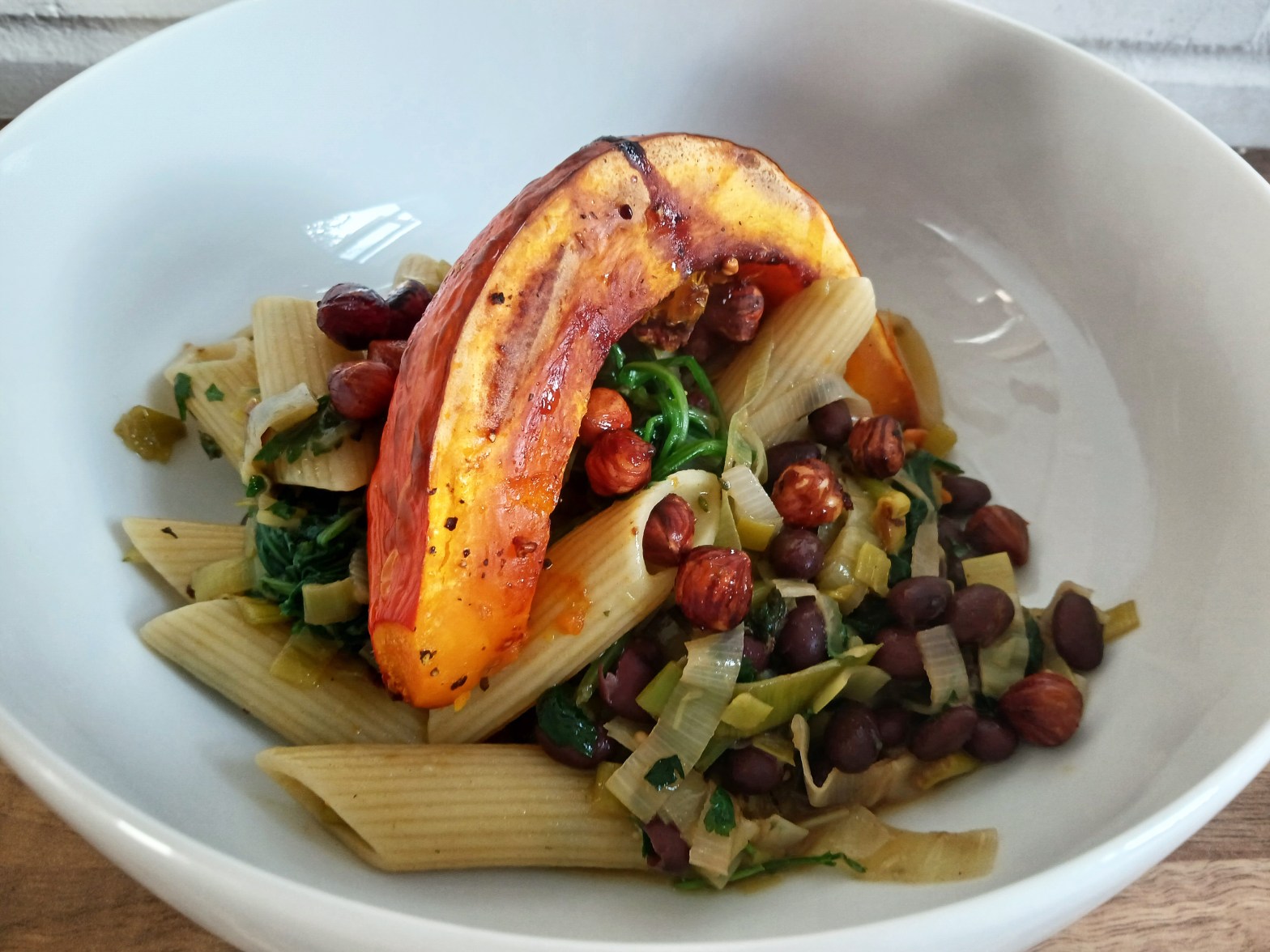
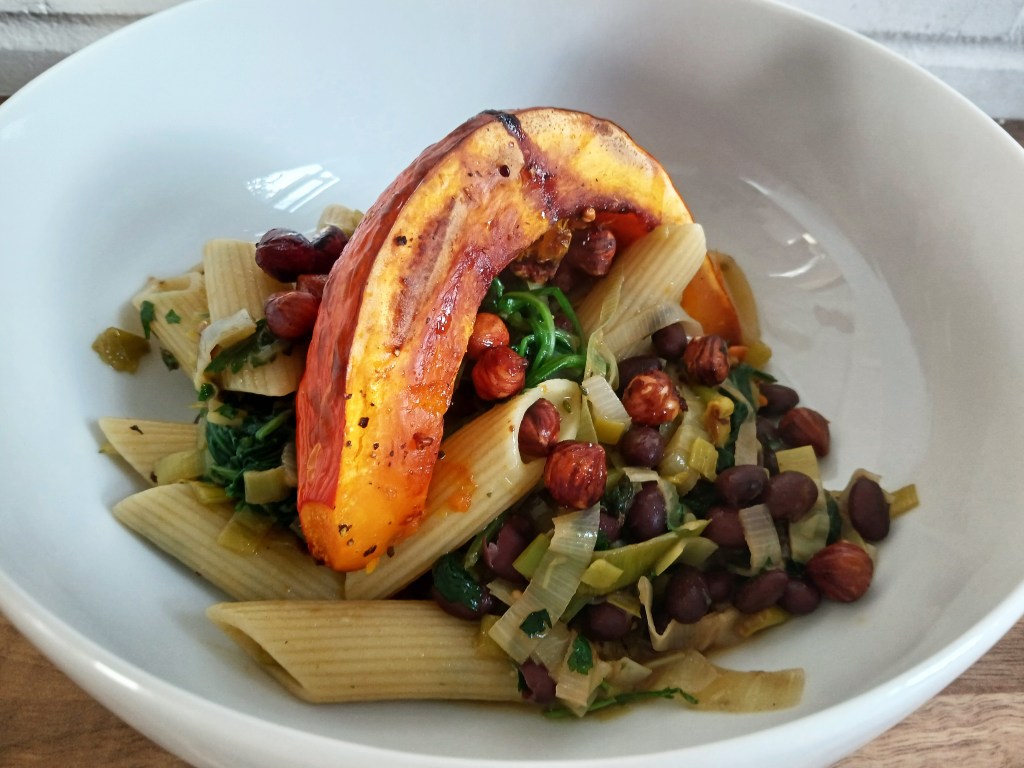
Seasonal and scrumptious this pasta dish combines English summer classics with fresh herbs for a subtle yet pleasing garden flavour. Added to that, the leeks melt in the mouth in the fresh tomatoes, while the syrup over the roasted squash and hazelnuts set off the whole dish.
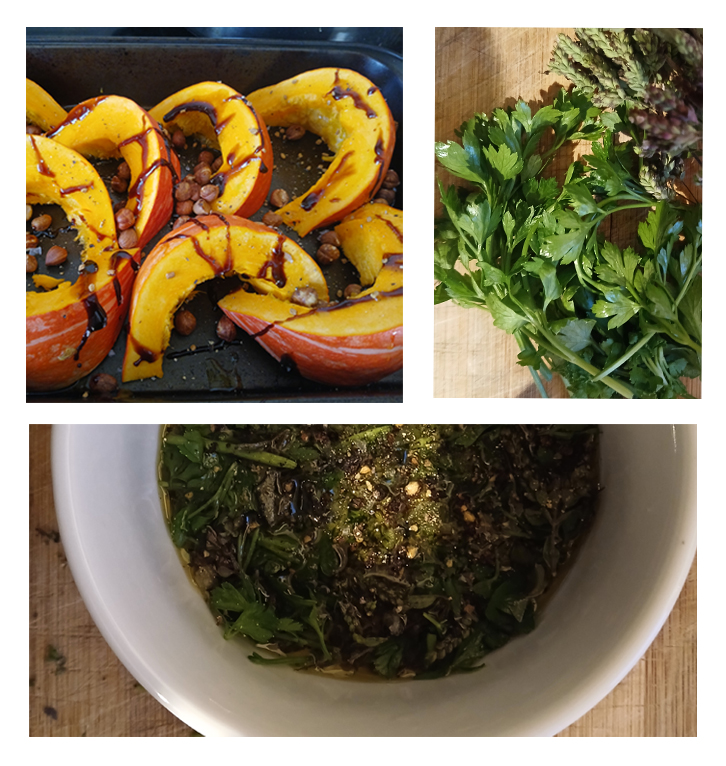
This one takes a little preparation as I make the salsa the night before and leave in the fridge to marinade. Start by finely choping the herbs removing any sticks or stalks. Place in a ramikin and cover with a cold pressed oil. Cover and leave in the fridge overnight.
The next day: Pre heat the oven to 200 degrees fan assisted (gas mark 6). Slice the squash and place in a roasting dish. Sprinkle the hazlenuts in to the roasting dish. Drizzle syrup over the nuts and squash. Then drizzle oil over the nuts and squash, adding a sprinkling of fenugreek, salt and pepper. Place at the top of the oven for 45minutes, checking it isn’t sticking half way through.
Chop the leeks and fry in oil in a large frying pan. If it is sticking, add a little more oil. Add the cherry tomatoes whole. Drain and add the can of black beans. Put the lid on and allow to simmer for 25minutes. The juice of the tomatoes should stop the leeks from sticking creating a tasy sauce.
Put the pasta on to boil as per instructions.
In a separate pan steam boil the spinach for a few minutes until wilted.
Once cooked, drain and mix the pasta and spinach into the leeks. Drizzle the salsa verde over the vegetables and mix thoroughly. Take off the heat and put a lid on until the squash is roasted.
When the sqauash is out of the oven, put the pasta mix back on the hob and reheat on a high heat for a few minutes. Serve pasta with a wedge of squash and hazelnuts on top.