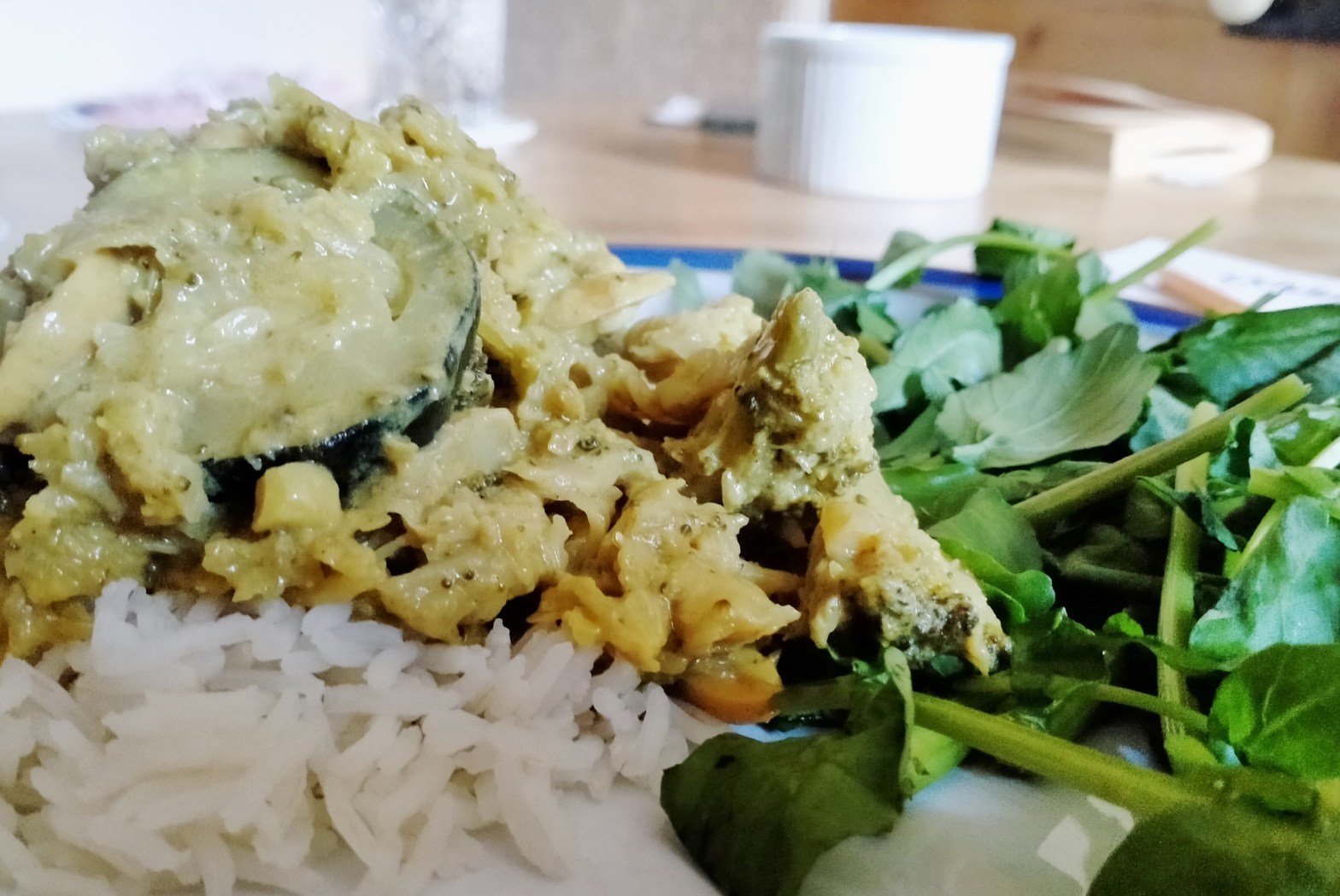
This creamy recipe made with lots of greens can be made mild or spicy depending on your preference. I personally enjoy mild food, and this curry makes for light comfort food, easy to munch with rice or couscous. Serve with leafy green for an extra vitamin boost.
Drizzle of oil
Fennel sliced
Broccoli (small) chopped
Spices (yellow madras mix)
Cashew nuts 200g
Coconut milk (1 can)
Cabbage (1/2 a large or 1 small)
Hot water
Courgette sliced
Salt
Add the spice, salt and oil to a large frying pan and sizzle. Add the fennel and broccoli and fry for 5 minutes until covered in spices. Add the cashew nuts and stir in. Add the coconut milk, stir and bring to the boil. Add the shredded cabbage and enough water so that the mix is not dry. Allow to steam for 15 minutes. Add the courgette and possibly more water – just enough to create some steam and to stop the mixture from becoming dry. Simmer for another 10 minutes et voila. Serve with watercress, salad, or kale along with your choice of grains. Unless your cashews are salted, this dish takes quite a lot of salt so season generously.
A super simple recipe, just needs a hot hot oven! Makes 12 puddings
200g self raising flour
1/2 teaspoon baking powder
50ml water
150ml soya milk
12 drizzles of oil
Blend the flour, baking powder, water and milk to create a batter. Pour into a jug, cover and out in fridge for 1 hour. Pre heat oven to gas mark 7. Add oil to each patty in a patty tin and heat in the oven for 5 minutes on the top shelf. Pour batter into each bun hole and bake for 30 minutes. Coordinate with other oven baking, for example with seitan bourguignon, which usually takes an hour on gas mark 4, can sit in the bottom of the oven while the puddings are cooking at a 7 (after 30minutes at a 4)
The Yoga Upanishads describe five sheats, or five bodies: annamaya, pranamaya, manomaya, jnanamaya, and anandamaya. These equate to the food body, the energy body, the mind body, the wisdom body and the bliss body. Just like the chakras, the koshas (Sanskrit for sheath/body) are on a spectrum of subtlety. The lower the body (the earlier on the list), the grosser it is. The higher koshas relate to more subtle things like consciousness and bliss. This coincides with the higher chakras. The lower koshas relate to the physical and emotional bodies, just as the lower chakras relate to the physical and energetic bodies.
Studying the seventh chakra is not easy. Few yoga poses work on the seventh chakra, notwithstanding headstand. Due to its lack of accessibility I often find that yoga teachers skip over the seventh chakra. This is a pity as openng the seventh chakra is the entire aim of yoga. I have noticed there is a connection between the heart and the seventh chakra. Indeed, opening the heart chakra could be considered the aim of yoga, and a lot of bliss emanates from here. If I had to make a disctinction I would say that an open heart brings earthly bliss, an open seventh is more like heavenly bliss, or an other worldly feeling where we have transcended our body, much rarer.
In yoga, we are aiming for open, balanced chakras along the whole spectrum. Aside from headstand, meditation is good for accessing the seventh chakra. Starting or ending your practice with meditation is one way to ensure you are paying the seventh some attention. Head massage is another way to stimulate the nerves around the top of the head and prepare the head for prostration pose (headstand prep).
When prana moves around the body it is sometimes possible to feel either a tingling sensation, heat or pulsation. This occurs when energy moves within the chakra, perhaps it is opening, closing, speeding up or slowing down. Chakras are wheels of light vibrating at such high frequcnies we cannot see them. There are hundreds of them all over the body, particularly at the intersection of the nadis, the energy channels, that flow around the body. There are believed to be seven major chakras along the spine, and it is these main channels that we often focus on during our yoga practice.
Some writers present the layers of the koshas almost in line with the seven chakras, In fact each of the chakras emits its own aura, so there are not five bodies, but at least seven. Each yogi must decide for themselves what they can see or sense in their aura. I have trouble grasping all five, or even seven auras at once. There is different energy that corresponds to emotions, thoughts and prana it can be useful to learn to watch the self in meditation, or with the ‘focussing’ technique, how the different information moves.
For me the seventh chakra is associated with the colour gold. When we are enlightened we are filled with a golden light and it is this source energy where we find universal consciousness. Universale consciousness refers to that space where ‘we’ the beings on earth are all one. The underlying energy that unites all the beings on the planet comes from the same source. We must remember this when we practice yoga. When we rest in the knowledge of oneness we are able to master our emotions and connect with those around us on a more authentic level.
If you cannot manage headstand, then spending time in prostration pose (kneeling with the crown of the head on the floor) will stimulate the crown chakra and possibly prepare you for half headstand and full headstand in the future. Don’t worry if prostration pose is as far as you can go, you will still rea the benefits. When we lie in shavasana at the end of an invigorating practice,we can sometimes feel the energy flowing up to the higher chakras, so be sure to finish with shavasana.
April has raced by and I am bringing this blog to you rather late in the day. As we spend our final moonth on the sixth chakra and start to focus on the seventh, we begin to approach the sea of universal consciousness and bliss The primordial sound, Om, is a bridge between the world of matter and the world of consciousness. As we chant, we contemplate that moment where energy becomes matter and the universe is formed, on the edge of infinity. As we reach towards the seventh chakra of infinite light, still working on the sixth, we chant Bolo Bolo Sab Mil Bolo Om Namah Shivaya. Shiva is the ruler of consciousness, traditionally associated with the sixth chakra, and its seed sound Om.
But Om opens us up to the intangible worlds of both the sixth and seventh chakras. Physically I’ve found the asana for this moonth packs a punch. I have managed to fit in seated half compass, standing leg bound pose, dolphin and scorpion. All practiced with an awareness of the sixth and seventh chakras it has helped me to find length in the spine and a greater awareness of the spiritual dimension ot my practice. My aura, the energy within it, the tensegrity throughout the physical body and the intrconnectednes of the seventh and fourth chakras all contribute to a feeling of lightness and openness in the body by the end of the practice. It reminds me how I felt when I was working on the second and third chakras together, it automatically opened y my heart space without necessarily focussing on it.
Working with the chakras in sequential order, particularly the second year running, I notice where there is openness and where I am closed. Patterns that I observed in year one are amplified in year two. Not greater stickiness necessarily but greater openness, and where there is a natural openning. Working on the sixth and seventh then, after six moonths of concentrating on the foufth and fifth chakras, felt liberating. I noticed my fifth chakra opening this year, as I worked on it, and this has had a ripple effect into the higher chakras. Technically silence is the seed sound of the seventh chakra but I have heard ‘om’ being taught also. At the end of chanting om there is a vibrational silence where the absence of sound almost manifest its own ethereal presence. The seventh chakra goes beyond three dimensional reality, into infinity itself. I am excited to focus purely on the seventh chakra next moonth. This gradual transition from the sixth, associated with thought and light seems to have paved the way for understanding an almost other worldly reality in the seventh.
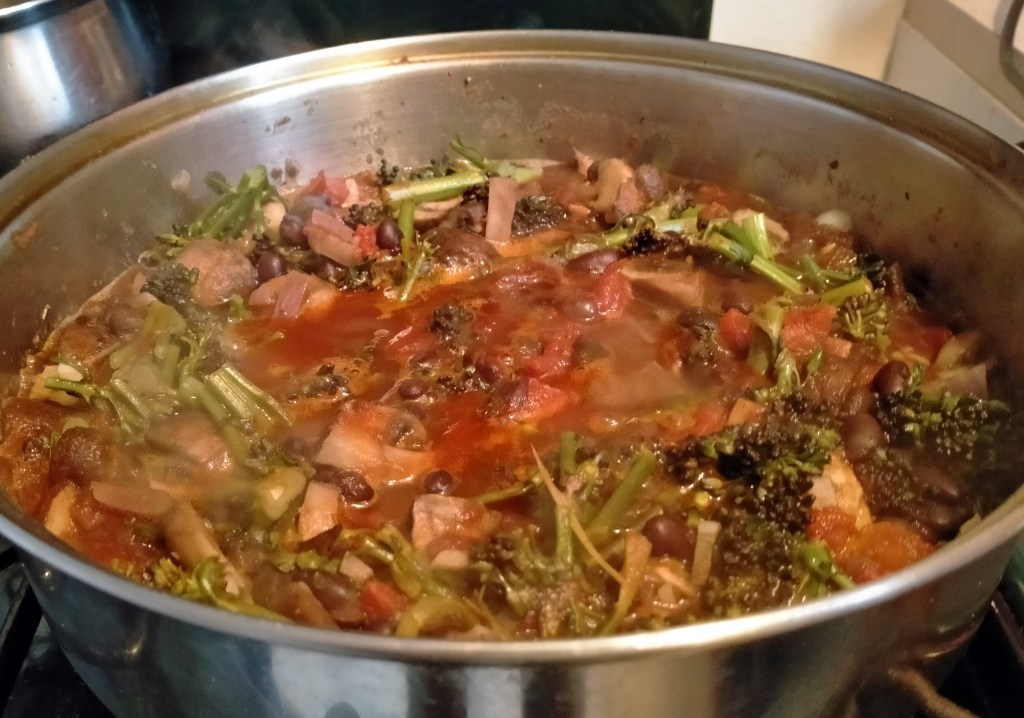
Simple and easy, this nutritious dish brings some of my favourite flavours together: black beans, tomato and mushroom. If you don’t like soya mince this recipe uses whole, vegetable ingredients only. The greens ensure you have a portion of iron and the black beans up the protein content. It takes an hour on the hob in total but most of that is simmering to let the garlic and herb flavours sink into the vegetables. Delizioso!
Red onion chopped
4 cloves garlic chopped
Mushrooms roughly chopped
Generous mixed herbs (2+ tsp)
Fry all of the above in a drizzle of oil until coated. Then add:
Can of Black beans
Can of tomatoes
Squirt of tomato puree
Choice of greens chopped (broccoli or kale)
Bring to boil and then simmer for 40 minutes
Serve with spaghetti and garlic bread for a traditional Italian dish, or with couscous and humous for a Mediterranean twist. (Serves 4)
The ajna chakra is another name for the third eye. Its powers of introspection can be awakened through meditation and asana. Ajna chakra is at that point on the spectrum of chakras where we move into the subtle realm, not only away from the visible, but away from the heard, the smelt, the tasted and the touched. Ajna chakra is often associated with thought, or the mind body. Some people believe we are made up of thought. The world is a hologram! It is a far out concept, but it is important not to become overwhelmed. What I find more helpful is the idea that by cultivating ajna consciousness, we are training the mind to watch itself think, we are growing what is called the witness state.
The witness state enables us to pull back, to detach, to practice aloofness, and to put others first. When we ignore the witness state it is all too easy to get carried away with our instinctive reactions, without consulting our self awareness. Without witness consciousness, we more easily act from a place of not knowing (the primary obstacle to yoga: avidya), we miss the context of what is being said, we miss embodied cues, we fail to sense what is going on in our aura.
The sixth chakra, is probably the most widely known chakra. The third eye is recgonised by Hinduism, and the New Age movement. Islam also touches the third eye to the floor five times a day in prayer pose, a dynamic child’s pose. Most of us can feel the space between the eyebrows as a slightly sensitive spot. Few of us spend much time contemplating that it is a link between the physical and subtle realms; the doorway between the finite and the infinite. In fact, all the chakra are such doorways. They are manifestations across all the five sheaths, the five bodies in yoga, connecting the physical, energetic, emotional, mind, wisdom and bliss dimensions. The sixth chakra is associated with the mind body, and it is said that we can hone our supernatural abilities by refining its power through asana and meditation.
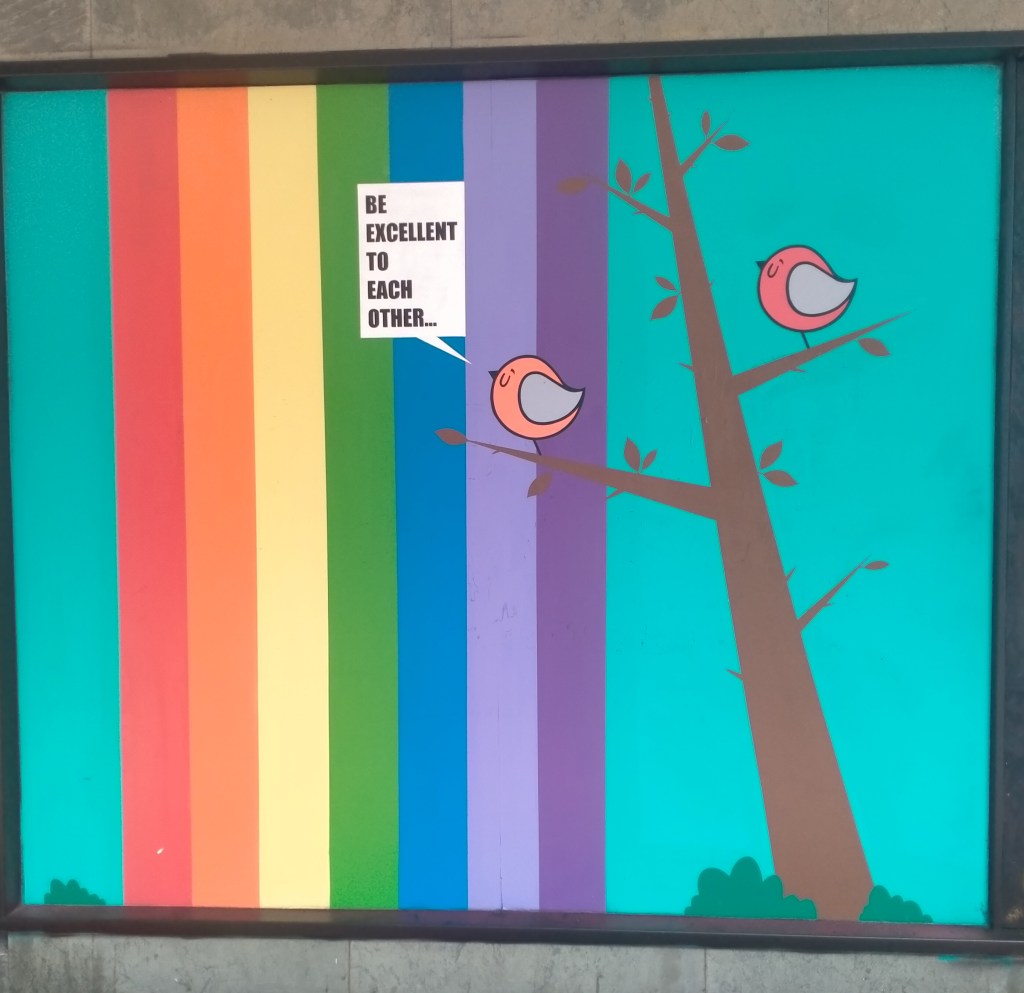
The concept of the witness is depicted in the beautiful verse from the Shvetashvatara Upanishad: two birds watching the world from the same mind. The two birds in the metaphor symbolise the small self and the big Self that live inside of us. The belief that the crown chakra is our gateway to universal consciousness and bliss could also be relevant here. One bird represents the all-knowing, all-powerful Self of the seventh chakra. The second bird represents the small self, the jiva atman, the small ego that operates at the human level as expressed by the accumulation of all the lower chakras.
If you were able to watch the self operate 100% of the time, you would be enlightened. Most of us don’t expect to achieve this, but by working on increasing the amount of light from the Self we shed on our self, we hope to lead a more enlightened existence. The birds on the tree tell the story of one bird eating ‘the fruit of pleasure and pain’ and another that sits ‘without eating’. In theory we could endure a lot more pain if we were able to sit with the bird that just watches, but this is a misreading of yoga. Non attachment can help someone manage pain, but it doesn’t take the pain away. We are all human, we all have the two birds. Even someone who doesn’t practice yoga usually has an inner voice that comes from a place that is seemingly watching what they are doing, thinking and feeling.
Learning to balance the two forces, the experiencing bird and the watching bird is part of the yogis practice. As we energise on the sixth chakra, we become more in tune with the force of watching the mind think. Awakening any of the chakra is a nebulous process and it is important to remember to incorporate grounding practices while working on ajna chakra.
The sixth chakra is often associated with the light element, while other times it is more closely associated with the element of thought. Thought travels through ether. Thoughts are certainly finer than air because science has mapped all the atoms found in air and it has never found a thought form outside of the brain. Ether is the absence of air particles; a vacuum. What is thought? Particles beyond the senses? When we open up the great unknown of the more subtler realms it is easy to worry that we don’t have the answers. But even science doesn’t have the answer!
Working with witness consciousness, we begin to watch embodied thoughts, memories, feelings, ideas, senses and reactions. When we watch the mind, we are learning a new language, we are beginning to see the unseen. It is important to learn the art of letting go as you learn to watch, and not get tied up with any one thought. This rule applies for all the chakras, whether you are looking at your feelings of survival, the way you reach out to others, the way you assert yourself, your ability to love, the way you express yourself. All of yoga is about managing thought forms. The sixth chakra introduces an aspect of self reflexivity: I know I am thinking therefore I am.
The sixth chakra brushes up against the infinite bliss world. It forces us to appreciate that there is a greater universal power and I am able to pull back and self reflect because there is something greater than my thoughts. As Shri Brahmananda Sarasvati used to say: ‘I am not the body and mind, althogh I have a body and mind, I am something greater’. The two birds sitting in the self same tree help us to understand that the infinite sits alongside the finite within our own being. We have a universe inside of us, we are marvelous, magical beings. When we learn to watch, we welcome the known and the unknown into our consciousness, we begin to see parts of ourselves that we did not know were there.
Easwaran, E. (1987) The Upanishads (this edition, 2007). Nilgiri Press: California p.170
The unknown authors of the vedic Upanishads wrote down the great wisdom of enlightenment. Each book remembers the experience of enlightenment and aims to share it with it the reader. In the Mundaka Upanishad we read how ‘[s]he is the source of love’ and cannot be known through thought, only love. In learning to love the self, we are freed from the bondage of sorrow. How do we get there? This text recommends meditating on a mantra taken from the holy scriptures. By performing japa meditation where the student repeats the same mantra again and again, the mind can be purified. One pointed focus can help overcome negative thought patterns, leading the student to greater self awareness, self control and self acceptance
A rhythmic mantra can attune to the natural pulsation of the body, helping the mind to be otherwise silent as the body moves through the day. There is something about filling the body with the energy of a silent mantra, indeed, the body becomes the arrow of devotion. When we establish a position of equanimity, or unconditional love, we are better abl to identify those areas that are less happy and that need attention. The target is the ‘Lord/Lady of Love’. whatever that means to you. When something gets in the way of that aim, then you can consider taking action, or changing course.
Meditating while repeating a mantra internally, particularly in tune with the breath, can help bring the content of the mind into focus. The mantra is usually a trusted holy verse that evokes a sense of peace. Meditation, as stated in the ashtanga path in verse 2.29 of Patanjali’s Yoga Sutras consists of dharana, dhyana, and samadhi. Concentration, sustained one pointedness and enlightenment are the three steps of meditation. A mantra that is repeated internally helps the student to practie one pointed concentration all day, not just when seated on the yoga cushion. You may be given a mantra by a yoga teacher, or your may find one of your own that brings you light.
When you fill your mind with the repetition of a holy mantra it helps you to fly like an arrow toward the Lord[/Lady] of Love. As my meditation teacher always used to say, in meditation you are building the muscle of awareness. Positive intention can be used to replace your autopilot. Instead of habitually reacting to situations and people around you, you can begin to hone your behaviour and increase the level of mindfulness with which you live.
As we move up the chakras towards the sixth chakra, we are reminded to meditate. Lord Shiva resides at the third eye and he is the ruler of meditation. Lord of death and destruction, but also resurrection and rebirth, the third eye centre finds its power in introspection, unleashing the power of transformation. By learning to watch the mind think we begin to identify the samskaras the bind us. The mental impressions that govern how we think, speak and act are part of the whirling mindstuff, the citta vrittis, that we come to witness when we learn to meditate. By watching the mind think, we come to know ourselves. Only by witnessing where we are now can we change how we think, speak and act in the future.
By studying the scriptures, and cultivating faith in our practice, we are able to devote ourselves more fully to self realisation. When we allow our mantra to breathe the body, we can live more fully in the moment as an enlightened being. As the breath passes over the throat and heart chakras, we are aligned with how th ebody is feeling, perhaps a more important source of awareness than what we are thinking about. A mantra helps ‘cross over the mind’ to access the wellspring of information that is the physical body. Through mantra meditation, by tuning in to the heart space and lessening attachment to the thoughts of the mind, the aspirant can become a vehicle of love. When we commit to seeking love in each moment, with every breath, we know that we are working for peace; we become an arrow of devotion.
(1) Easwaran, E. (1987) The Upanishads (this edition, 2007). Nilgiri Press: California pp.190-1
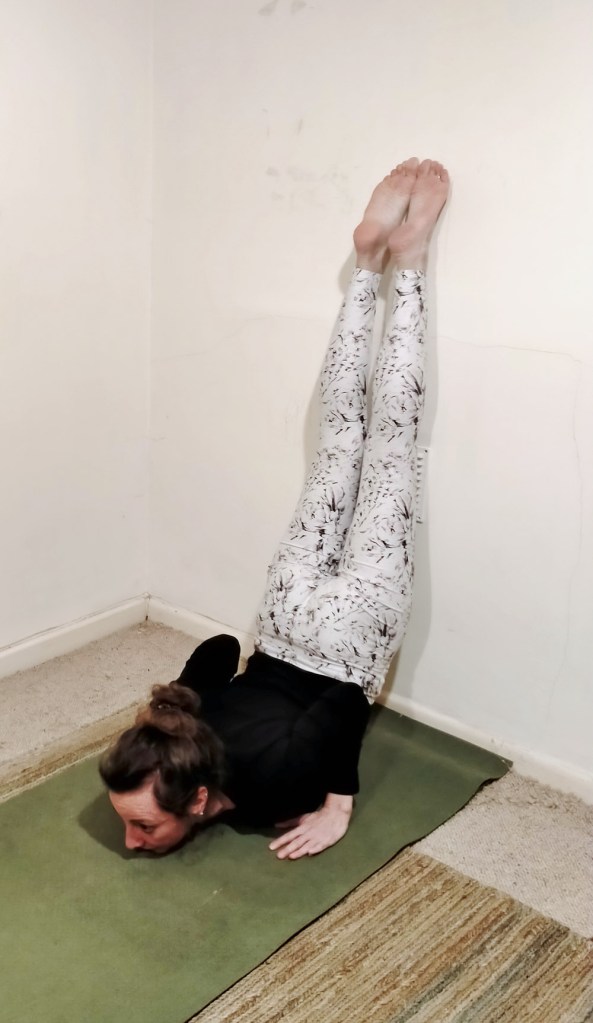
The peak pose of this moonth’s routine is the advanced pose Gandha Bherundasana. It relies on core strength to enter and exit the pose, and is challenging even using the wall as support. The weight of the body is on the chest and chin with legs in a locust variation. The pose is a throat opening position and can feel constricting. By taking the awareness to ajna chakra during the asana, feelings of balance and calm pervade the body. For beginners I would recommend locust variation on the mat. The pose requires arm strength and an open neck, as well as core stregnth to get into and out of the pose safely. *try this pose at home at your own risk, make sure the wall is free from clutter and your have space either side of you to enter and exit the pose. Ensure you have warmed up.
Locust variation
Warm up for the pose includes child’s pose variations, ashtanga namskara, arm balance pose, locus, and the upward and downward facing bows. The pose is taken from Iyengar’s Light on Yoga (1), and is a preparatory pose for an even more challenging variation where the feet touch the head, and the weight is born by the face. I have never seen anyone perform this pose, but I wonder if praticing this variation of Gandha Bherundasana will eventually enable the more flexible students to achieve it. It certainly demands strength and flexibility to an extent that few yoga classes demand.
This is the last of the throat centred practices and I must say it has been an eye opening journey. My focus on the chakra of truth brought up all kinds of things hidden in my unconscious and I am quite grateful to move on to the sixth chakra! The intersection between the fifth and sixth chakra marks that place where truth and purification meets insight and decision making. It is a place where Sat – truth, meets chit-thought, so I have christened this lesson Satchitananda. The element associated with the sixth chakra is either thought or light, depending on what version of the chakras you subscribe to. The key to understanding the elemental associations is that the most dense element, earth, starts at the root, becoming lighter and more subtle as you move up the chakras. I personally believe thought is more dense than light, so conclude that the sixth chakra is associated with thought rather than light (see discussion in Chant and Be Happy). The ajna chakra, located at ‘the third eye centre’, next to the eyes that look out, is close to the internal gaze, or the mind’s eye. The throat chakra is associated with sound, and perhaps that point where the fifth meets sixth chakra encourages us to look for internal sounds, beyond our day to day perception: the pulsation of the heart, the rushing flow of blood through the veins, the whisper of the breath.
Advanced poses are particularly good at honing the power of ajna chakra. Just as we face adversity and challenges off the mat, we recreate these testing times on the mat with difficult postures. We aim to maintain our internal gaze despite the external challenges that we face. More advanced poses call on the student to watch their breath and to connect with their higher powers of interoception. In the Yoga Sutras of Patanjali, it is said that intense practice bring results more quickly, while moderate practie brings moderate results (2). As we move up the chakra system we begin to engage the more advanced spiritual powers, or siddhis. Where the lower chakras are about regulating the emotional body, our relationships and our ego, the higher chakras empower us with more subtle skills like discrimination, clairvoyance and transcendence. We can achieve great things with the higher chakras. But it is important that we have prepared the body and mind by conditioning the lower chakras first. When we practice with chakra awareness we can begin to unlock these hidden powers It takes patience and consistent practice, but by challenging the body and exploring new areas of openness and flexibility, we can access our own higher power.
(1) Iyengar, B. K. S. (1966) Light on Yoga (this edition 2001) HarperCollins: London. p.342-343
Two essential concepts in the yoga world: proprioception and interoception. Both terms relate to a process of turning inward. Proprioception means awareness of the physical body, as it moves through space. Interoception means having awareness of the spiritual, or mind, body. Both in proprioception and interoception, rather than looking at our body we sense it. Both rely on the activity of the mind to process information about the body. They are distinct in that the sense organs that the mind relies on to interpret the internal information are different.
The physical body relies on informaiton from the nerves attached to muscles, bones, tendons, ligaments, even veins and organs. In proprioception, we have a sense of what is going on in our body to a greater or lesser extent. Yoga aims to increase that bodily awareness. In meditation we we feel the body, we perform a body scan, we breathe into different areas of the body.
Interoception is more nebulous than proprioception. Interoception relates not only to internal physical sensations, but emotional states aswell. I like to think of it as more directly connected to the mind’s eye, the internal gaze, or ajna chakra. When we become aware of stillness behind the breath, when the pulsation of the heart floods the body, when we experience spaciousness, all of these require our powers of interoception.
The two concepts combine when we confront the idea that memories and emotions are stored in the physical body. When we find the energy of a loved one near our heart space, that is using interoception, but it is at the borderline of the physical and ethereal worlds, perhaps arguing with them causes tangible heartache. The memory of that fight becomes embedded in an energetic body, hidden from the physical senses, it informs the way that we relate to them, and to others. Through yoga, we are able to clear out that stuck energy, in this case by working on the heart chakra. Through interoception, we bring things into awareness.
Most yogis practice with the awareness that the body has an aura around it. This is a relatively easy concept to grasp, however invisible to the naked eye. Akin to an electromagnetic field, all living beings have an etheral casing. This is fairly basic yogic knowledge. What’s more difficult to conceive, or at least I find it so, is that there are places where the chakras are believed to exist within the space of the physical body. Indeed, the chakras are believed to connect the many different non physical, or energetic bodies, to the physical body, all layered on top of one another. In Theosophical system it is believed that there are seven principles each pertaining to a different body; in clasical yoga there are five koshas or bodily sheaths divided into three, the astral, causal and physical bodies.
In yoga we aim to work on the physical, mental, emotional and pranic bodies, in order to access the bliss body. We use the eight limbs of yoga: asana (physical practice), ethical observances and restraints (mental/emotional), pranayama (pranic), pratyhara (mental, pranic), and dharana, dhyana and samadhi (a fusion of all the bodies through one pointed concentration). We attempt to merge with the bliss body, or access information stored in it; the akashic record or causal body.
When we practice yoga we aim to enhance our powers of both proprioception and interoception. Trauma can create barriers to understanding, or insight, as can the five obstacles to yoga [read more on the kleshas here]. Building these powers is a gradual process, and learning to discern what is gong on in our aura and chakras takes years of practice, calling on all the limbs of yoga. Yoga is not just a physical practice requiring a good level of proprioception, but it also calls on us to enhance our capacity of interoception. Cultivating an internal gaze through meditative practices including mindful asana work is key to building this kind of spiritual strength.
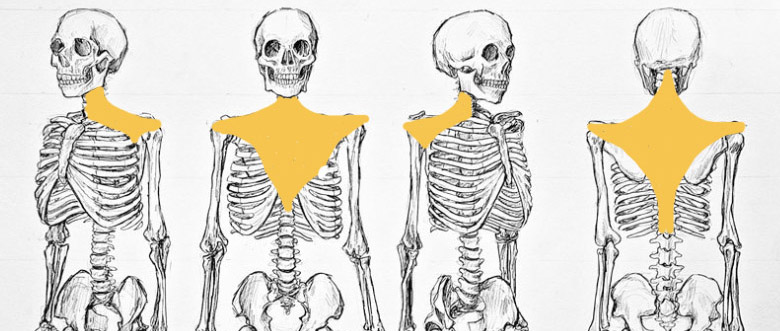
This moonth I am working on the throat chakra. It is connected to the heart below and the ajna chakras above. When I practice neck stretches, I become aware of the tensegrity that connects the body, via the fascia, from one chakra area to another. Moving the head slowly either side to side, or up and down, you can see for yourself, all the muscles as far as the heart chakra, down the back and the front of the body, are stretched.
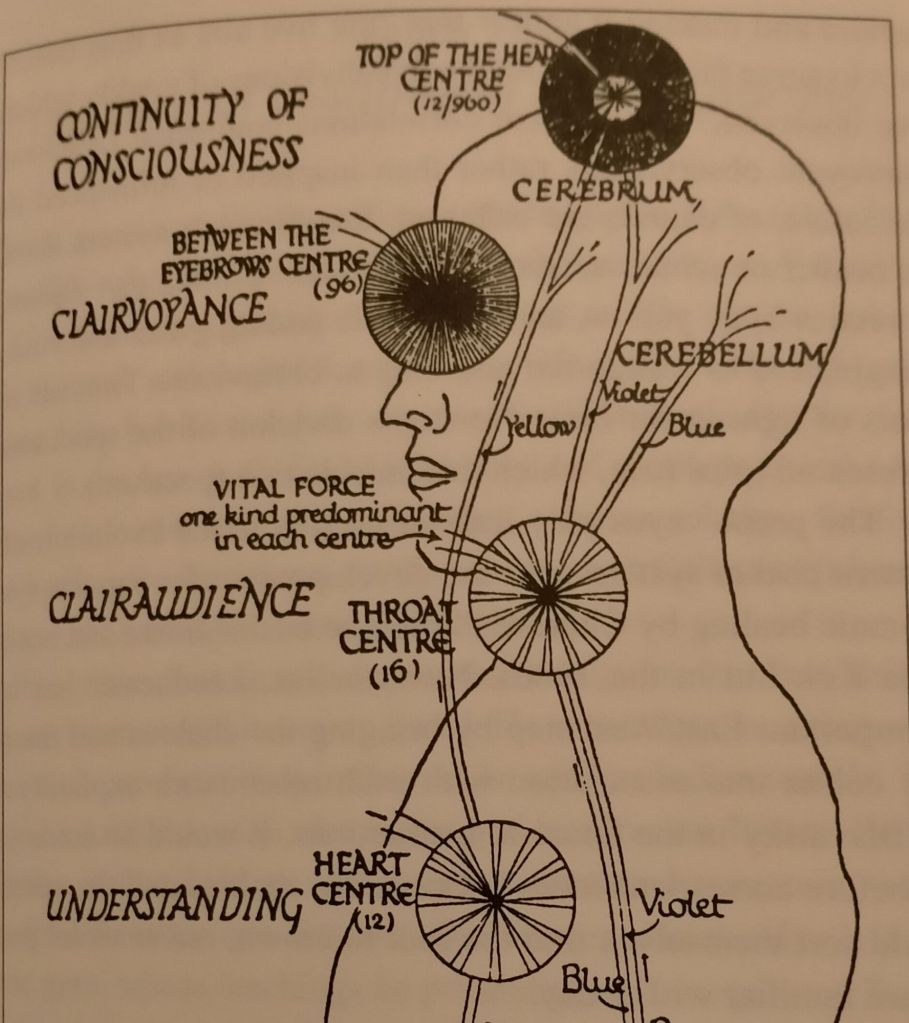
No chakra is worked in isolation from the others, and few poses focus on a single chakra. I have noticed that as I deepen my focus on the throat chakra, I open my heart chakra; backbends become more accessible and, at the end of a session, I feel elevated in such a way that is only achieved by opening the heart. The diagram above shows how the neck and throat connect to the heart space. By opening one chakra, we open the other.
The verse from Katha Up. suggets that there is a fine line connecting the heart to the crown of the head. This conection is psychological, or in some way more subtle, than a physical line that you can find in the body. The verse makes it clear how fragile the connections between the chakras really are. Out of a hundred and one lines, there is but one that reaches to the crown. It requires sensitivity, patience, and discernment to transcend the physical body and find enlightenment. The verse also suggests that both immortality and death are present within the body at the same time. This gives us a clue that in practice, we cannot embody light 100% of the time throughout 100% of the body.
I am increasingly aware of other connections between the chakras. Did you know, when you work on one chakra you are also workingon alternating chakras? So th odd numbers are stimulated simultaneously, as are the evens. This means that when working on the fifth chakra, I am also stimulating the first and third chakras, likewise, the second, fourth and sixth chakras tend to be activated together. This is explained when you read Rosalyn Bruyere’s Wheels of Light; the chakras are grouped together by polarity (2), the odds express energy, the evens take it in. Alternating chakras are also linked to the primary curve: the neck (fifth chakra), lumbar (third chakra) and legs (first chakra) are all secondary curves. The sacral (second charka), the heart (the fourth chakra) and the skull (the sixth chakra) are part f the primary curve.
The verse quoted above, from the Katha Upanishad, reminds us that the heart chakra is connected to the seventh chakra. There is in fact a continuum between all seven chakras that enable energy to travel from the base of the spine to the crown of the head, and in some belief systems, back down again. All the chakras are connected with each other, regardless of their differences, via the sushumna, ida andpingala channels. Through practice, these energy channels revealthemselves.
I find the connection between the heart and seventh chakras recurring in my awareness. Both are major channels of compassion. The heart is the home of loving kindness, the seventh universal consciousness and bliss. Unconditional love is often what we are searching for when we seek enlightenment. Some people even believe there is a second brain the heart, which guides us and helps us to connect to others. To be filled with love for all beings is surely an elevated state. Is there a special connection between the crown and heart chakras? This verse suggests so. When one informs the other, we can imagine that an elightened state would follow.
In drafting this post I have come across a diagram from 1925 that suggests there is indeed a direct link between the heart and the top of the head chakras. I must also mention that the connection was cemented by a simple visualisation that was taught to me just last week (serendipitously) by Tarik Dervish. ‘Imagine a silver thread connecting the heart to the head’, he said.
From Rainbow Body reprinted from The Etheric Double
When I imagine the heart space connected to the crown, I imagine being flooded with a sense of the infinite, silence, and light. By visualising an image of a fine thread connecting the heart to the crown, I find that my posture comes into alignment, my head lifts, my necks lenthens and my heart opens.
In view of the verse, ‘there are a hundred and one vital tracks, one of them rises to the crown […] the others to death’ I am made aware that there is darkness inside me, just as there is light. In navigating this three dimensional world I know I will encounter pain and suffering, as much as there is light and love. The truth is not always easy to bear, sometimes it is elusive and we have to be ok with not knowing. When we work on the throat chakra we invoke the truth, but we also confront that space of darkness, that centre of secrets and deception. It can be painful, or difficult to integrate new found truths. By taking support from the wellspring of love in the heart and bliss in the seventh chakra, this lesson somehow makes working on the fifth chakra easier to bear. Love doesn’t mind if you don’t know everything, you are entitle to be blissful no matter what you know.
The truth, or the purported truth about a situation can make enlightenment difficult. We worry, we ponder, we get nervous, we escape. There is only one truth out of hundreds of possiblities, and it might be some time before we know what the truth is. Only the fullness of time will deliver the satisfaction, or the horror, of knowing for sure how something will turn out. So when we focus on the fifth chakra, we must learn to park our ideas, and others’ projections, and carve out a small space for our true heart line. Unknowing and unknowable, but perfect just the same, we strive for the freedom of immortality and enlightenment. The Katha upanishad reminds us that sometimes the pathway to bliss only emerges when we acknowledge that there is pain and death within us. Then we know, We are not that pain, we are light and love.
(1) Easwaran, E. (1987) The Upanishads. Canada: Nilgiri Press, reprint 2007
(2) Bruyere, R. L. (1989) Wheels of Light. New York: Fireside p.78
(3) Leland, K (2016) Rainbow Body. USA Ibis Press p.195








 Sarasvati Flow