Creamy Mushroom Pasta

Scrumptious creamy pasta with a zesty salad, quick to cook, serves 2

Drizzle oi oil

2-3 cloves garlic chopped or crushed

10 medium mushrooms quartered

Bag of spinach

Oatly creme fraiche (or other vegan substitute)

Spaghetti

Salad leaves

Lemon, oil, wholegrain mustard dressing (whisk together in small dish with a fork)

Salt and pepper

Add, enough oil to fry garlic and mushrooms to frying pan. Put on the spaghetti to boil. Add spinach to frying pan (as much as you can pile up) and allow it to wilt somewhat before stirring. Add creme fraiche once spinach is half way wilted and stir gradually. Once pasta is cooked add it to the frying pan and combine with sauce. Dress salad and serve.

Lentil Soup

A classic lentil soup, accented by the celery and tomato. You can play with different spices and herbs. Makes a batch of 8 portions – perfect for your lunch time protein hit, and freezes well

Bag of lentils (500g)

Onion 1 finely chopped

Carrots 2-3 diced

Celery – 1 bunch diced

Potatoes x 3 medium cubed

Can of chopped tomatoes

Spices of your choice e.g. cumin, garam masala, fenugreek: 4 teaspoons

Little oil, salt and pepper

Add oil and spices to a large boiling pan, add onion, carrots and potatoes to fry in spices. When veg is coated in oil and spice, add lentils and can of tomatoes. Cover with boiling water from the kettle. Bring to boil them simmer for 1-2hours until cooked through

Feel The Body: Yogrrr

This moon I am focussing on the intersection between the second and third chakras. Our watery, emotional relationship with the Other comes into contact with our fiery, self serving ego. This lesson is all about embodiment boundaries and is particularly worthwhile for anyone who has ever felt like a door mat, or a people pleaser. Last moon I considered that moment of reaching out to another, this moon I am asking the question, what happens when that moment comes into contact with my ego? The third chakra is all about me, my and mine. It is self serving, and, unchallenged, it will enact my will at the expense of others. Many people need to work on this chakra because they are used to getting what they want, ignoring others’ desires, hurting people’s feelings, using or manipulating ohers for their own gain. In some ways the third chakra is the quintessential yogic focus. If we talk about building self awareness, our ego is the most obvious thing we can see in ourselves, it is where we are selfish, defensive,and controlling.

When we look at the third and second chakra intersection we are inviting ourselves to correct and rebalance our boundaries with others. If you never ask for what you want, you will never get it, but likewise, if you are treating people badly, I guess that can bite you in the bottom in the long run too. Where are you on that spectrum? Do you demand what you want and expect to get it, or are you patient and quiet? There is no right or wrong way to be. What is right for one person is wrong for another. We practice yoga for peace of mind, and there are different ways to get it.

Mostly we seek peace in our relationships with others, and I am intersted in challenigng the notion that it is ok to let people walk all over you. If you feel like you have relationships where you are not heard, maybe its time to look for ways of expressing yourself more clearly. Take an assertiveness course, go to drama lessons, learn to sing. I chant every day as part of my yoga practice. It is a key indicator of how I’m feeling. To be honest, I have to be feeling pretty low, drained or distratced not to want to sing. If I know, thanks to my yoga practice that I am not feeling strong, then I can choose to put up stronger boundaries both of self care, and in how much I give to others. 

Unless you are doing karma yoga, yoga isn’t all about giving to others. Through meditation and self study you can begin to notice when you are letting others take advantage of your energy, or good nature. Instead you can learn to resist being too generous with your spirit. People are generally much more grateful for something they have to fight for, so not giving yourself away is an art to be mastered. Over time, trial and error will help you gain ground in your relatinships with others. If you have a propensity to be a shrinking violet, use your self awareness and awareness of others to work up some grrr: say no, refuse to smile, be aloof once in a while. I’m not saying be unkind, but little adjustments made with yourself in mind, could just give you the space you need to be the person you want to be.

Seafood and Eat It Pasta

Indulgent seafood pasta in the spirit of some non vegan dishes I enjoyed when I ate fish, but this is minus any animal products. It can be made with your choice of pasta and is surprisingly quick and easy for something that tastes so rich (serves 4)

2 – 3 cloves garlic chopped finely

1 small onion chopped finely

1 packet of Tofuna mashed with a fork

4 handfuls of pine nuts (or any chopped nuts)

2 generous handfuls of dried seaweed salad leaves

2 teaspoons of tarragon, salt and pepper

Half a bag of spinach

1 pot of oat creme fraiche

4 portions of green beans, cut into short halves

4 portions of pasta, why not try linguini or spaghetti

2 drizzles of oil

Fry the garlic, onion, Tofuna, pine nuts, seaweed, tarragon and spinach in some oil in a frying pan. At the same time put the pasta and green beans on to boil. When the pasta is nearly ready add the creme fraiche to the frying pan to make a sauce and heat through. Drain the beans and pasta and when the sauce is ready stir together over a medium heat. Serve and drizzle with oil to finish

Abhinivesha: Fear of Death

When I first leaned to meditate, it wa s a profound experience. I learned to develop a new relationship with myself on a breath by breath basis. I would observe the inhale, and I learned that if I welcomed it with openess and kindness, I was able to create a positive, gentle attitude towards myself that nourished me. Even as I write in this very moment, I am still cultivting that sense of observing with kindness. That first lesson in meditation was, it seems, still with me. 

I learned that the exhale, the active part of the breath, requires more patience. And it was here that I found my fear of death manifesting. Not like sheer terror, but as I watched myself breathing and I noticed my chest tightening, particularly as I neared the end of the exhale, it was as though I was fearful that I wouldn’t take another breath. Or if I did that it would be full of complicated emotions. This is where I learned to trust. Trust in nature, trust in myself, trust in my life force. From this moment of realisation, I instntly felt freer and more at ease. I had been carrying around this fear of death with me for a lifetime. As I slowed the breath, I could sense myself slipping into its trap on every exhale. Abhinivesha is not one of the five kleshas for no reason. It is an obstacle to samadhi because we unconsciously slip into its clutches quite easily, and it is full of fear.

The exhale is also a good place to get curious. Ask yourself, what am I feeling? We all want to breathe easily and be kind to what we encounter, which means being honest about what we find when we look inside. I’m not sure I would have believed my inner landscape was so detailed and changeable when I first started meditating. In many ways, I long for those early days when I was learning to watch my self, before I knew how complicated I was, and how much I had to learn. I know now that I was looking at the first layer of self awareness, before I peeled away all the other layers that were waiting for me inside.

But it wouldn’t be very honest if I ignored everything that I have found since those days. And on reflection I think I am lighter for digesting all the ‘goo’ that I have discovered during my many of hours of meditation since. The instances of abhinivesha have become more varied, and my appreication of its sensitive nature, especially when sensing it in other people. Fear of death can be allied with all kinds of feelings, and it is often masked with anger, rage even. Finding it in someone else is equally tough. The sensation can be very uncomfortable, but the longer I am able to ‘be’ with it, the sooner I can realise what I am looking at and compassion can become the greater emotion.

Self and Other

This moon I am working purely on the second chakra, and find it quite fitting that the peak pose is Turtle. Meek, mild turtle that likes to introvert when things get difficult. Ironic that this is a pose associated with the second chakra as we work on our ability to connect with others. Perhaps for a yogi, perfecting the art of introversion, like a turtle, is not such an illfitting metaphor around this chakra. Often what is true about ourselvs is true for others, and in many ways learning about the self is also learning about others. 

I am struck by how much I am drawn to hip opening in general. It could be that my star sign Pisces is aligned with the second chakra, ruled by Jupiter, associated with the colour orange, as well as being connected to the water element? So I feel a particular affinity for the second chakra. Lotsof us store tension in the hips, so working on the hips is a popular focus in many yoga classes. Releasing tension in the body helps us move more freely and communicate with others more openly; the more we are at ease with ourselves, the more we are ease with others.

I am inspired by a description of pecans in Braiding Sweetgrass, and how the pollen from the male plant trusts the wind to carry its fertile seed to a female plant waiting down wind, in order for the tree to fruit. It is abeautiful miracle that in this way the plant has learned to survive. Through all the processess of evolution, plants and trees have come to trust the wind to fertilise them. I think this is the ultimate example of trust because without the wind, the plants would die out, yet the trees have little control over the wind. In fact many plants rely on a male and a female plant that grow separately, united only by the wind, they are called dioecious. Kimmerer writes that ‘[i]f the wind can be trusted with that fecund responsibility, why not with messages?’ as she introduces the idea that plants might talk to one another. 

As I imagine the plants swaying in the wind, I imagine myself walking along the street absorbing and releasing prana from and to the people that I encounter. I’m not seeking to pollinate the people, haha, but there is something in the fluidity of a swaying branch that inspires me to move with confidence. Fixed, yet mutable, my flwoing self gets curious about the people that I meet. What are their stories, how are they today, what’s their style?

I think it’s no accident that water is associated with the chakra of reaching out to others. Water is fluid, curious and receptive, and in order to meet others with sensitivity we need to embody these characteristics. We need to open our eyes, expect the unexpected, and trust that the wind will bring us the people we need to take the next step. But in order to get along wth others we have to change ourselves a little, we have to pause to receive th e other.

By nature, others are different. As my yoga teaher says, ‘every wave is unique’ and so we are all unique. However similar we may seem on the outside, our imprint on the world, our persepctive and our character are different. It is these differences that make the world an interesting place, but it can make it challenging too. Things that make one person laugh can make another shout, and yet another cry. Pausing to look inside, to align with the moment, to know where the person is coming from because you have seen these feelings in yourself, to create a feeling of neutrality and quiet, in spite our differences, that is wherer connection can be found.

Our meditation on the mat, in the form of asana, teach us to watch the m ind move in challenging situations. We also learn to still the mind, and to be present in the moment through embodiment. We learn to wacth the breath and to apply the bandhas all helping to prepare us for those moments when we come into contact with others. Our yoga practice helps us to see the self in others as well as to embrace the differences.

Lentil and potato pot

For those days when you just want a simple thick nourishing soup, this one is easy to eat with melt in the mouth potato, and lentils smooth, thick curry laced with spices and herbs, beans for extra protein, and greens for iron. Serve in a bowl, suitable for all ages, serves 4-6

dice red skin potatoes

+ oil, spices (5-6 curry leaves, 1 tsp fenugreek, 2 tsp cumin, 2 tsp thyme), salt and pepper

+ enough lentils to cover potatoes and stir fry together

+ water to cover, and 2 tsp of corn flour

+ chopped kale or other greens

+choice of beans

simmer until cooked, stirring occasionally (45min-ish, if boiled dry add more water)

serve with chapati, or on its own – with two sources of protein, plenty of carbs and greens this is one wholesome dish all by itself!!!

Asparagus and black beans dressed in lemon, with olive, watercress and blueberry salad

Bursting with flavour this makes a light, nutrient dense dinner, serves 2-3

Potatoes (3 medium, cubed, skins on)

Black beans (one can, cooked and drained)

Asparagus (one bunch cut into 2 inch batons)

Paprika 1-2 tsp

Bay leaves 

Salt and pepper

Lemon and mustard dressing (use a fork to whisk lemon juice with wholegrain mustard and sesame oil, in equal parts)

Fry potatoes in sesame oil and paprika. When potatoes almost cooked, add asparagus and black beans to frying pan for a few minutes, until heated through. Serve and drizzle with lemon dressing.

For salad:

Watercress – chopped

Black and green olives – pitted and chopped

Blueberries

Blueberry juice – drizzle

Add ingredients to a bowl and drizzle with blueberry juice and oil. Serve with bread

Knowing the Self Through the 5 Klesas

अविद्यास्मितारगद्वेषाभिनिवेशाः क्लशाः

avidyāsmitā-rāga-dveṣābhiniveśāḥ kleśāḥ

PYS II.3

The kleśas are said to be the key obstacles to samadhi, bliss. If you can surmount these then you are good to go as an enlightened being. Ha! Easier said than done. There are quite a few lists, tips and tricks in the yoga sutras of Patanjali, and the list of five kleśas is one of them. It is believed that the kleśas can be destroyed through observation:

the kleśas become like burnt seeds, scorched by the fire of discrimination, and thus they become unproductive, and one is no longer subject to these afflictions and the kliṣṭa (detrimental) vṛttis they produce ( 1 )

It is only by watching the mind move through these obstacles, or afflictions, that we can become aware of them, exposing them to the fire of discrimination. When we meditate we create a space to watch the mind move, free from the distractionfs of daily life, even just five minutes a day can make a difference. Here is a brief run down of these five points to work with in the jouney to self awareness.

Avidyā technically means ‘not knowing’, the verb vid to know, and a as in the Greek, not, or without. Avidyā is most commonly translated as ignorance, but this can sound a bit harsh when you’re rooting around your psyche, and of course the most important thing in this case is to be kind to yourself. It is sometimes said that Patanjali and his students ordered the sutras so that the most important things come first, like Ahimsa before Satya in the niyamas, and in this verse it is avidyā that takes first place. To be in a position of ‘not knowing’ is one of the toughest places to be. ‘Give me a clue’ we find ourselves saying, trying to find our way out of the clouds that blind us. ‘I’ve got thi nagging feeling’ we might say to a friend, ‘I can’t put my finger on it’ we say to ourselves as we grapple with some unseen, unresolved feeling that is trying to tell us something. This is the primary obstacle to samadhi. Figuring out tricks to decipher the feelings inside of me is one thing that yoga has taught me. Ways of moving, ways of breathing, patience, flexibility of mind, all these things help to dispel the darkness that obstructs the mind from seeing clearly.

Asmitā, or ego, is possibly the funniest of the kleśas. Having learned to watch my mind, the things I watch my mind getting hung about is almost shameful. But it’s important to approach this task of getting to know the self with forgiveness. Its hard to be a yogi and not laugh at yourself. Shadow sides of the ego include anger, controlling others, manipulating situations, or believing that ‘I am the doer’ rathe than something greater than us. It’s hard to say more without spoiling the next point, but yep you guessed it, raga attachment, and dvesha, its opposite, hatred or aversion shape much of what we see in ourselves when the ego is in operation. I guess you could say that ego or asmitā is rāga and dveṣa in their nascent states. If you can catch yourself moving into ego thenyou can stay in a place of buddhi awareness, where the veil of ego fails to move you.

Rāga means attachment, and since learning to watch my mind, I have found myself atached to all kinds of things. If you’re one of these people who likes things to be ‘just so’, identifying attachment in your persoanlity can be liberating. Perhapas you see it in someone else, and instead of feeling stifled you can let it go, laugh even. Knowing where I cling to things has been one of my most valuable lessons. The hope of positive transformaiton that yoga brings through this kind of learning is why I love yoga. Greater self awareness fosters greater, connection.

Dveṣa means aversion or hatred. Rather than clinging to something, you are desperate to change it, or make it disappear. Dveṣa can be very uncomfortable, particularly when you are unaware that you have slipped into this ‘exterminate’ mode, it can be too easy to feed the pain and slip into a downward spiral. We are taught to be good children in assembly at school and negative emotions are much less explored, so our tool kit to deal with these kinds of emotion are more limited. Maybe things have changed, I don’t know, but certainly in my day, we weren’t welcoming hatred with openness and curiosity. Perhaps it take a certain level of maturity. I feel like saying at this point that some aversion and hatred can be a good thing, it protects us from what we don’t, or cannot understand. As with all the kleśas, they are there for a reason, and our jounrney to samadhi an ever evolving process. We can only see little bits of our self at a time, and it’s useful to accept them before moving to change them. Somewhere in the space between rāga and dveṣa is equanimity, or non-attachment, a massive Buddhist topic, and one of the keys to enlightenment. By observing rāga and dveṣa we can more easily cultivate a space of equanimity.

One of the first Sanskrit words I learned was abhinivesha. It means fear of death. I remember being impressed that yoga had a word for this concept. We hear so little about this kind of fear and yet it is with us consciously, or unconsciously with every breath we take. When you let go of this fear, or overcome it, you can experience samdhi. Abhiniveśā, however difficult an emotion to conten with that it is, I find it more tangible than avidyā. Avidyā is your blind spot, abhiniveśā smacks you in the face with anxiety, it narrows your vision, it tenses your body. I think the solution to this feeling is positive community. Yoga encourages us to look inside, but also to seek sangha. It is very difficult to survive without people around you, not impossible, but difficult. Sangha is a community of likeminded individuals that can help overcome feelings of fear. Of course you can also work to overcome feelings of loneliness. Being alone won;t kill you, although you can feel that it might. The beauty of being entirely self sufficient needs to be balanced with your own karmic need for companionship.

We have looked at ignorance, ego, attachment, aversion and fear of death as the five key obstacles to enlightenment. Whichever klesas you most easily identify in yourself, learn to watch the feelings inside you, then you can bgin to know yourself, then you are on the journey to self realisation.

(1)Bryant B. F. (2009) Te Yoga Sutras of Patanjali. New York: North Point Press. p.175

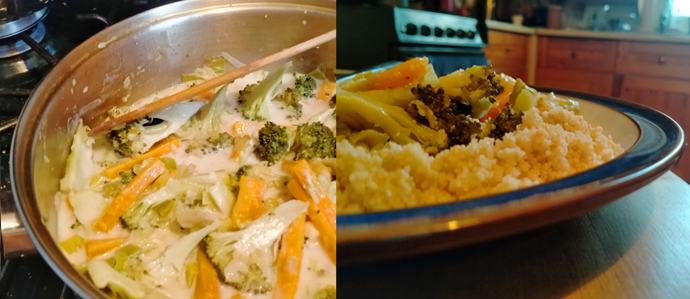
Thai green curry

Classic, simple, non-spicy English take on the traditional Thai green curry. So simple, so delicious. Serves 2-3

Carrots x 2

Leek x 1

Broccolli x 1 small

Thai green curry paste (half a jar) 

Coconut milk (one can)

Lemongrass (fresh from the plant if you can get it)

Chop and fry veggies, add paste, add coconut milk and simmer for 30-40 minutes. Serve with couscous, rice or noodles. Simples!