
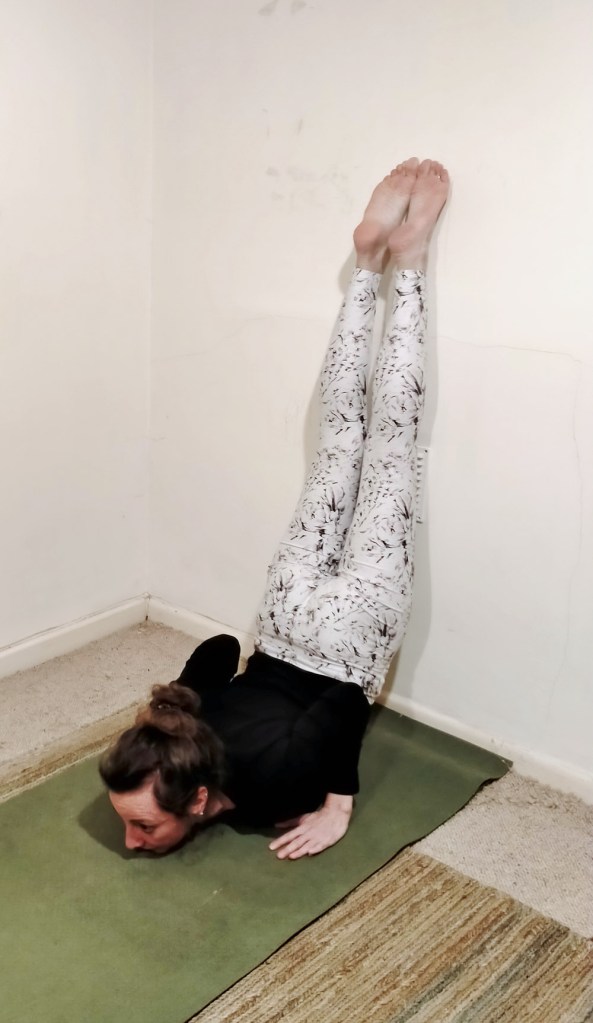
The peak pose of this moonth’s routine is the advanced pose Gandha Bherundasana. It relies on core strength to enter and exit the pose, and is challenging even using the wall as support. The weight of the body is on the chest and chin with legs in a locust variation. The pose is a throat opening position and can feel constricting. By taking the awareness to ajna chakra during the asana, feelings of balance and calm pervade the body. For beginners I would recommend locust variation on the mat. The pose requires arm strength and an open neck, as well as core stregnth to get into and out of the pose safely. *try this pose at home at your own risk, make sure the wall is free from clutter and your have space either side of you to enter and exit the pose. Ensure you have warmed up.

Warm up for the pose includes child’s pose variations, ashtanga namskara, arm balance pose, locus, and the upward and downward facing bows. The pose is taken from Iyengar’s Light on Yoga (1), and is a preparatory pose for an even more challenging variation where the feet touch the head, and the weight is born by the face. I have never seen anyone perform this pose, but I wonder if praticing this variation of Gandha Bherundasana will eventually enable the more flexible students to achieve it. It certainly demands strength and flexibility to an extent that few yoga classes demand.
This is the last of the throat centred practices and I must say it has been an eye opening journey. My focus on the chakra of truth brought up all kinds of things hidden in my unconscious and I am quite grateful to move on to the sixth chakra! The intersection between the fifth and sixth chakra marks that place where truth and purification meets insight and decision making. It is a place where Sat – truth, meets chit-thought, so I have christened this lesson Satchitananda. The element associated with the sixth chakra is either thought or light, depending on what version of the chakras you subscribe to. The key to understanding the elemental associations is that the most dense element, earth, starts at the root, becoming lighter and more subtle as you move up the chakras. I personally believe thought is more dense than light, so conclude that the sixth chakra is associated with thought rather than light (see discussion in Chant and Be Happy). The ajna chakra, located at ‘the third eye centre’, next to the eyes that look out, is close to the internal gaze, or the mind’s eye. The throat chakra is associated with sound, and perhaps that point where the fifth meets sixth chakra encourages us to look for internal sounds, beyond our day to day perception: the pulsation of the heart, the rushing flow of blood through the veins, the whisper of the breath.
Advanced poses are particularly good at honing the power of ajna chakra. Just as we face adversity and challenges off the mat, we recreate these testing times on the mat with difficult postures. We aim to maintain our internal gaze despite the external challenges that we face. More advanced poses call on the student to watch their breath and to connect with their higher powers of interoception. In the Yoga Sutras of Patanjali, it is said that intense practice bring results more quickly, while moderate practie brings moderate results (2). As we move up the chakra system we begin to engage the more advanced spiritual powers, or siddhis. Where the lower chakras are about regulating the emotional body, our relationships and our ego, the higher chakras empower us with more subtle skills like discrimination, clairvoyance and transcendence. We can achieve great things with the higher chakras. But it is important that we have prepared the body and mind by conditioning the lower chakras first. When we practice with chakra awareness we can begin to unlock these hidden powers It takes patience and consistent practice, but by challenging the body and exploring new areas of openness and flexibility, we can access our own higher power.
(1) Iyengar, B. K. S. (1966) Light on Yoga (this edition 2001) HarperCollins: London. p.342-343
(2) Patanajali’s Yoga Sutras 1.20-1.22
 Sarasvati Flow