Lots of fancy words in the title of this post, but what do they all mean? Tensegrity is a portmanteau (oo there’s another one – it means combination!) of tension and integrity. It’s what makes the body parts move in tandem with each other. The foot bone is connected to the leg bone, the leg bone is connected to the hip bone etc. Our bones are tied together with the muscles and connecting tissues, and its al l wrapped up in fascia, a gloopy sticky mucous found under the skin thathelps defend the body from harm.
When we practice yoga, we challenge the body to move smoothly from one pose to the next, or even from one breath to the next. The movement of the body, particulalry in vinyasa flow, relies on the different parts of the body working in a harmonious whole. Exted the hand and the arm moves, extend the arm and the shoulder moves, and so on.
The contraction of certain muscles, depending on which pose you are practicing, will be different. The muscles usually work in pairs while one set contracts, the other relaxes. Concentric contraction occurs when the body is moving, an the contracting muscle shortens. Eccentric contraction sees the muscle lengthen, even while its under pressure. Isometric contraction is where the muscle length does not change. This occurs in yoga when a posture is being held.
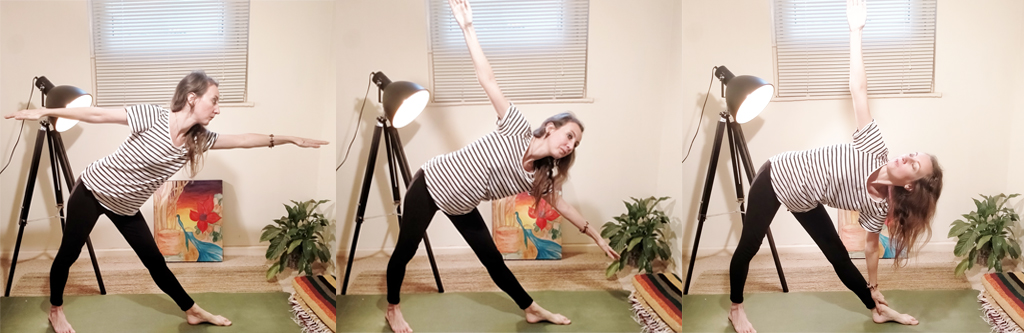
Rather than holding a weight, a yogi works with the natural weight of the body. Let’s imagine trikonasana. The torse is reaching forwards, the spine extending through the crown of the head. The arms are extended from the shoulders in opposite directions. Both arms and torso intially extend thrugh complementary concentric and eccentric contraction, but once in the pose, isometric contraction takes over. There is very little movement, apart from the breath, instead the main work of the muscles is holding the body in place. The torso is parallel to the ground, as gravity is working on the weight of the head and upper body, the waist is like a pivot between the legs and upper torso. Liekwise the arms are being held in place, extending outwards, upwards and downwards, slicing through gravity and relying on the tensegrity of the arm muscles to open the heart space. Isometric contraction means that the muscles are almost static in position, but they are working against gravity to stay in one place.
The transition into trikonasana feels much like dancing, and I think it is because of the tensegrity inherent in it. The legs are rooted into the ground, the front arm extends forward parallel to the floor, and the head follows. This is a perfect example of tensegrity at work. All the parts of the body follow the same narrow line, not wider than your foot width apart. Legs are active, which draws the abdomen in. The arms are active opening the chest. To finish it off the head turns to face upwards, and the gaze leads, drawing the head with it. Holding the pose, torso suspended in air, relies on half the muscles being isometrically contracted, and that is whre you can appreciate the tensegrity. The body is active, yet unmoving, working yet poised.
 Sarasvati Flow
One thought on “Isometric contraction: working with the tensegrity of the body”