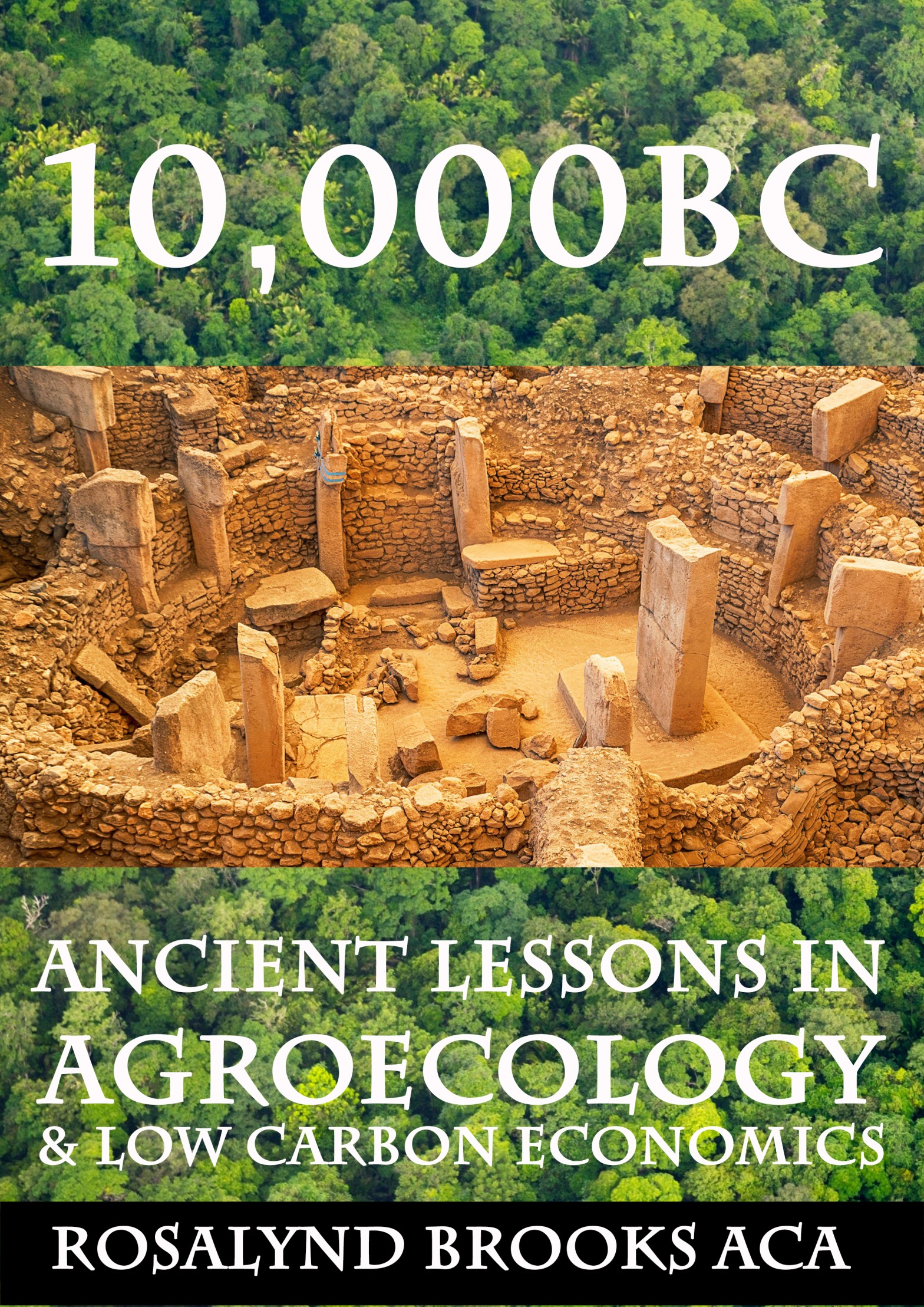
I am pleased to announce the release of my new book, which I’m releasing as a free e-book today, Earth Day! 10,000BC – Ancient Lessons in Agroecology and Low Carbon Economics is an all you need to know about agroecology, what was wrong with the green revolution and why we don’t want another. Follow the link to download your free copywww.10000bc.org.
What is agroecology? What is low carbon economics? As we transition to net zero what do we ‘the people’ need to do to make organic food for all a reality? There are a multitude of solutions to the climate crisis being offered in the farming world today, but not all of them are organic. As COP28 recognises the need to sustainable agriculture1, what does that mean for a country like Britain where 83% of its citizens live in the city and less than 1% of us are farmers? The emerging theory supported by a number of stakeholders, farmers, and policy makers, is that we need a smallholder revolution: a million new farmers to work the land. How practical is this suggestion? Even if we recruited enough farmers, can agrocecological solutions feed the world?
10,000BC: Ancient Lessons in Agroecology and Low Carbon Economics takes the reader on a journey back in time to the dawn of farming. What made us start farming in the first place? As we face a farming crisis today, what can we learn from our prehistoric ancestors? In the last 12,000 years, the population has grown exponentially, and materialism ballooned; what are the underlying cultural implications of these changes? How have we historically reacted to global food pressures? Do we need a new economic focus; an alternative to high growth economics?
Agroecology is a method of sustainable agriculture that cares about the lives of the farmers, the consumers and the land. It aims for equality, justice and diversity so that good food is not only grown, but also distributed to everybody. 10,000BC introduces the idea of agroecology, alongside low carbon economics, with an action plan to grow real food for all. It aims to be a practical and accessible text on agroecology introducing the concept to new audiences that are interested to know more about the solutions to the current industrial farming model.
The text introduces the idea of ‘panic farming’. Historically, short termist solutions that create more problems in the long term have been touted as panaceas, but it is the slow and steady approach that will win the race. First it was population growth, now it is climate change. Do we really need to resort to panic farming when agroecology offers solutions to these crises?
115,000 words with over 850 references, 10,000BC weaves prehistory into the modern story of agriculture. Throwing light on the alternative to the modern industrial paradigm, the book explores the cultural and economic shifts required to challenge it. The text aims to question the industrialism that dominates popular opinion and decision making in agriculture.
My journey as a food and farming campaigner started in Uganda in 2010 when I worked as an accountant for a charity trying to raise money for polycultural homesteads. The smalholdings were considered the most efficent use of land, as they are climate change resilient and connect peasants with enough resource to supply themselves and the home market with food. My journey into agriculture continued in India that year, when I stayed in Auroville, performing a systems analysis of the food and farming units supplying the spiritual community. When I returned to the UK, I lived on mixed ecological farm Church Farm Ardeley working as an intern for the Oxford Real Farming Conference (ORFC) and then the All Party Parliamentary Group (APPG) on Agroecology. Following that I founded Farm the City London connecting urbanites with food growing spaces and running an annual festival.
Before taking time out to write this book, I spent over a decade as a chartered accountant. I qualified with top 5 firm BDO LLP in 2009, then went on to work as Financial Controller for various Small Enterprises (SMEs). I have an English Literature and Cultural Criticism BA (Hons) from Cardiff University.
1https://www.bbc.co.uk/news/science-environment-67594303
 Sarasvati Flow