After practicing and teaching (on and off) Jivamukti for over 8 years, I decided in 2020 to develop my own method that was slightly more accessible for the students I was teaching. I experimented with one approach and then another, until in the last year I have taken it to a whole new level, bringing my students with me. Let me tell you about my journey with Saraswati Flow ‘through the chakras’
Today, I’ve just completed 14 lessons designed to work systematically from the root chakra up to the crown chakra changing every new moon from Spring 2022 through to Summer 2023.
Previously, I have worked onmy chakras in workshops, DVDs and reiki, but I wanted to experiment with the idea of working on each chakra individually over the long term, like a whole year with a month for each. Most yoga lessons focus on one chakra area, or one body part, but how many teachers focus on the whole seven for the whole year?
I started with a routine that focussed on the root chakra. Then I moved on to root-sacral. I am having issues with what to call the inbetween areas but have found myself counting, one, one-two, two, two three, three, three-four, etc etc.
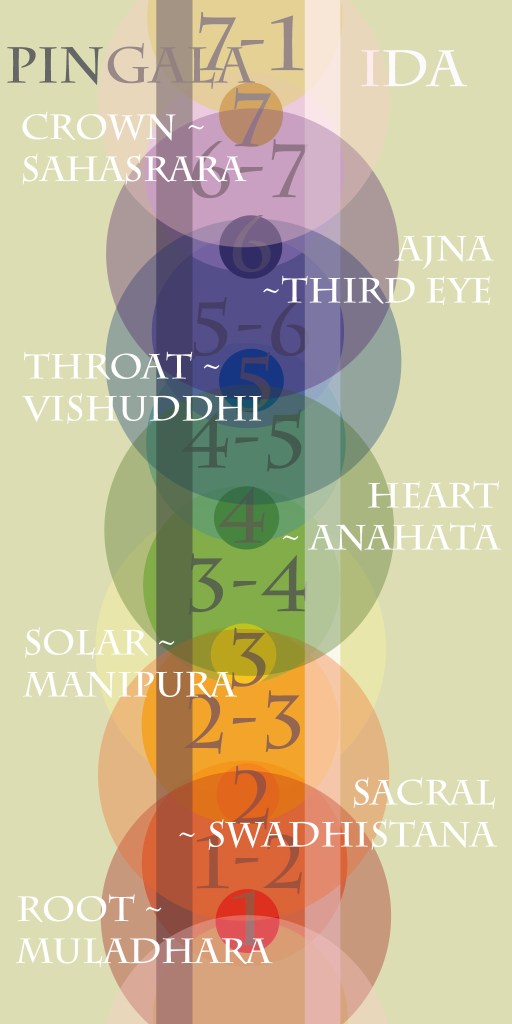
Why not focus on just seven areas?
I first designed a routine with a double chakra focus as part of my training with the British Wheel. I wanted something that would get me into King Pigeon pose in an hour. I noticed that by working around the illio sacral and psoas muscles, I was actually working between the first and second chakras. When I was asked to write another routine, I decided that I would challenge myself to write a 6 – 7 routine focussing on the ajna and crown chakras. I realised that we are always combining these two areas instead of affording them their own separate class. But I also noted that treating them together created itsown kind of vibe. I came across the term ‘dual awareness’ in David Treleaven’s book Trauma Sensitive Mindfulness. It is a psychology term that means learning to watch the various parts of the mind. I began to appreciate that when we practice with an awareness around two chakras areas, we are cultivating an ability to watch more than one thing at once. So as I moved into King Pigeon I was confronting issues of stability in my home and sense of self (first chakra), as well as cultivating a sense of openness with which to face Others in my life (second chakra). I began to wonder, perhaps it is the complexitity of these peak poses that is so appealing.
When I combined the chakras and practiced each routine in sequence, I noticed that the prana moved moved more quickly up my sushumna into my heart space. Linking one routine to the next over the space of a year resulted in a very thorough practice. It is extremely methodical requiring dedication and consitent practice, but it works. By practising on each chakra individually and each chakra with the next, you effectively work on each chakra three times a year. That’s three moons each! I ended up working on sacral chakra and solar chakra with the added bonus that my heart was opening too, it was quite spontaneous. I wanted the classes to be challenging, while being slightly less demanding than Jivamukti, a method I had practiced for nearly a decade. So what I have dubbed Saraswati Flow is meant to be more accessible to the average yoga student, and I can slim each class down into a beginners format as well, so I will always be able to practice what I teach regardless of the level of student I am teaching.
What’s important in a yoga practice, and what I aimed to avoid, is that you don’t pick and choose your favourite or least favourite areas to work on, every area is given an equal amount of time and attention. I realised as I approached the end of the year that I had never spent so long on the higher chakras and I really had to research quite a bit to find the right peak poses. Of course every routine gives each and every chakra a work out so they can be practiced individually and if you wanted to treat an area then they design should be well rounded enough to do that. But I had a lot of fun exploring the higher chakra in so much detail; the fifth, sixth and seventh chakras all demanded a new level of design that focussed on the upper half of the body including the head and neck. I opened up my shoulders in a way that I never have before in quite such a short space of time. I even designed a seventh chakra routine with 9 different headstands incorporated into it!!
It’s easy to see the chakras as quite distinct from each other, but when you combine them it invites you to consider the themes together, and what happens when you combine the elements, as we do all the time unconsciously? Where do we see earth meeting water on planet earth? The depths of the ocean, the bottom of a riverbed? Earth can be the source of life, but without water it can be as lifeless as a desert. Fire of the ego and air of the heart space are quite a natural combination too, but when we consider them in a yogic context we think about directing the air of the heart space, of infusing it with unconditional love, and imagining how this then informs the ego, fuelling the fire for elightened activism. When you become aware of these things, as shifts in our elemental makeup, you can work to ground, to find stability, to find the kind of earth that will hold the water in a safe space away from the fire, or whatever it is that you think you need. The idea of yoga is that it gently soothes each of the areas bringing the body into balance, building strength in all areas.
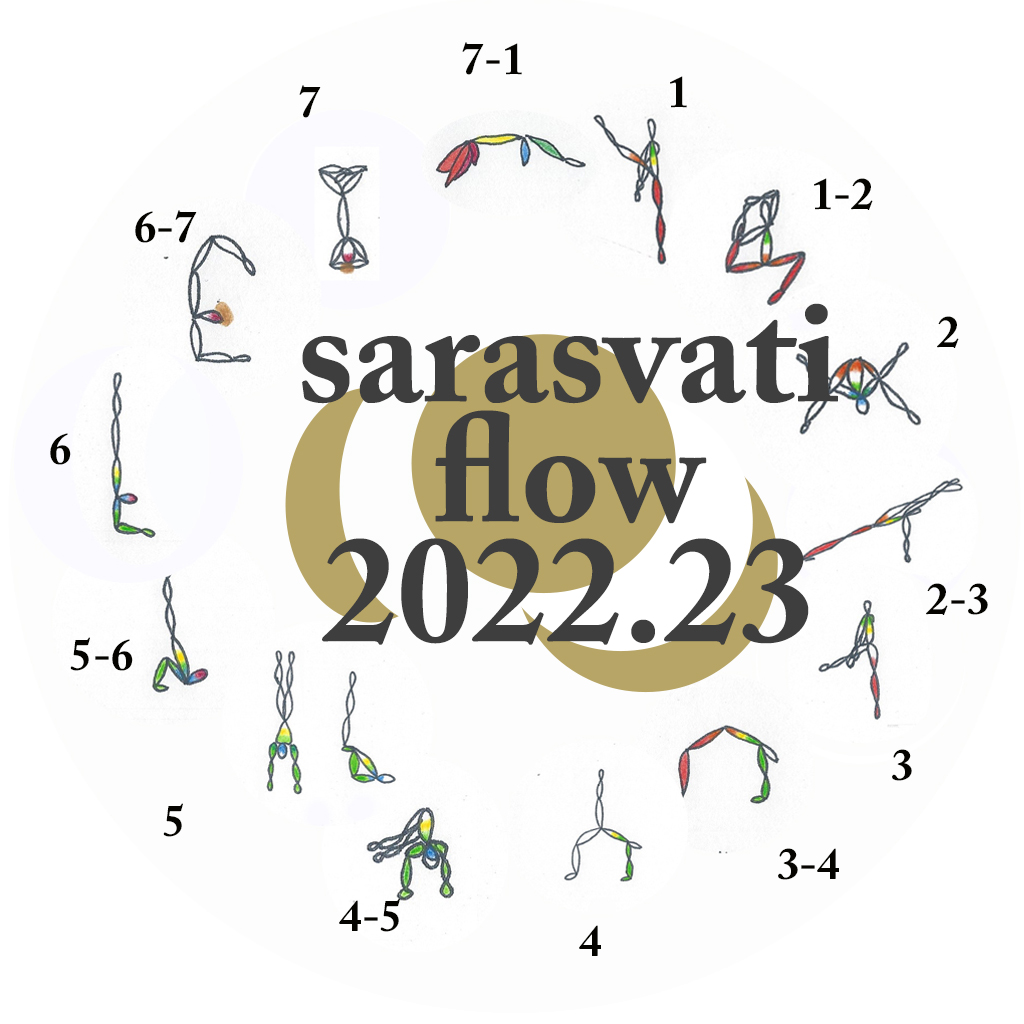
In the design of the 14 moons I wanted to experiene the jungle, to travel around the world to nature’s most beautiful places. I begin with bird of paradise and end up with tiptoe fish travelling past turtle, dolphin and scorpion, amongst others. While yoga is about connecting with the self, it is also about escaping the mundane, and journeying into the mystical. A good soundtrack helps with that.
I plan on practicing the set of 14 routines again over the next 14 moons taking me to midsummer 2024. Abhyasa means to practice in Sanskrit, and it can also mean repetition. I practiced the Jivamuti Spiritual Warrior sequence solidly for about 2 years and found that my body resposnded well to the fundamental moves that it contains. The hour long routines that I have designed as part of Saraswati Flow are quite similar to the Spiritual Warrior, but they contain a peak pose and a unique warm up tailored to the chakra focus. I like the predictability that repetition brings, I am able to monitor my progress more easily and feel where I am each day bringing me into a closer relationship with myself.
I finish with a pranayama and chant, chosen to suit whichever of the 14 chakra foci I am working on, meaning I enjoy a rich class experience every time I practice. There is even a short meditation thrown in, so a full class of yoga takes about 75 minutes.
Without wanting to disparage any of my previous yoga teachers, I guess I could say that until now, in chakra terms, I was jumping around. I studied so much yoga history, and the ancient texts with different teachers, that to order it by chakra and reflect on the sutras with the echoes of this early tantric knowledge was quite an experience. There isn’t a lot about the chakras in the earliest yoga texts, it is mostly limited to references the seven levels of heaven, but my own experiences have been enough to convince me that a physical exploration of the seven chakras could inspire a fulfilling internal journey. I am curious how it will feel to work on grounding, heart opening and meditating at different times of the year, in light of the astrological calendar. But as we are not limited to sun sign astrology I think it will work. Given that teachers are supposed to practice what they teach, I wanted to share more about what I am practicing, so students can join in with more awareness. The monthly newsletter describes each of the pranayama practices, includes a recording of the chant and describes the peak posture. So if you are interested to join me, and to deepen your own practice on this journey, please sign up to the newsletter.
 Sarasvati Flow